Norway
 Sweden
 Finland
 United Kingdom
 Denmark
 United States
Modernising finance functions in multi-academy trusts (MATs) is essential for future growth and ambition. As MATs in the UK grow in size and complexity, finance leaders who prioritise modernisation will be better positioned to deliver greater value to students and comply with tightening regulations.

For MAT finance leaders, the question isn’t whether modernisation is a priority; it’s how to achieve it effectively with limited resources.
And the answer for many academy trusts lies in modern education finance software, whether that is cloud-based or education ERP software. A modern system is the foundation for cohesive, scalable financial control.
Learn how we support MATs and other educational institutions by visiting our market page
Why modernisation is now essential
In recent years, the structure of the education sector has changed dramatically. In England alone, there are now over 10,000 academies operating. Approximately half of all schools are part of academy programmes, and MATs are fast becoming complex multi-entity organisations. [1]
The regulations set out by the Department for Education (DfE) are also being developed so that trusts demonstrate strong financial management, clear accountability, and efficient funding usage across all schools within the group. However, legacy and on-premises systems were not designed with this level of scale in mind, and often inhibit steady, sustainable growth through poor integrations and a lack of real-time visibility.
So how can MAT finance leaders approach modernisation? Here are 5 steps MAT finance leaders can consider when focusing on digital transformation.
Step 1: Establish clean and accurate financial data
The first step to creating a modern finance system is reliable data. Modern accounting systems provide a single source of truth to all other business areas, so ensuring the data that will sit within your new finance system is accurate is essential for success.
By replacing bad data with unified real-time information, MAT finance leaders gain better oversight of budgets, spending, and performance across all schools and departments, improving financial control. This shift alone can significantly reduce manual reconciliation and enable faster reporting cycles.
The most immediate benefit we observe is the transformation of reporting from a periodic, resource-intensive exercise into a continuous, self-service capability.
Andrew Fraser, Director
Moore Insight - Xledger UK Partner
Step 2: Move to a cloud-based model
Functionality isn’t the only outcome of modernisation. MAT finance leaders should also consider the accessibility and scalability of their new finance system. A cloud-based management system allows finance teams to access data anytime, anywhere, on any device with an internet connection. In a world of remote working and back-office finance teams, this type of accessibility supports collaboration across central teams and individual academies.
Cloud accounting management software also removes the maintenance costs associated with on-premises infrastructure by reducing IT contracts and always enabling access to the latest version of software available to MAT finance teams.
Step 3: Integrate finance with school management software
Integrating finance management software with existing business management systems is key to ensuring finance does not operate in isolation. True modernisation arrives when MATs connect their financial data across all systems, as this improves efficiency and accountability across all departments, from budget holders to approvers, all the way up to trustees and governors.
Here are a few examples of systems to integrate your finance management solution with:
- Human resources and payroll systems
- School management software
- Management/student information platforms
Connecting these platforms creates better resource management where finance leaders can align budgets with staffing and student information, ultimately strengthening operational efficiency and reporting capabilities.
“Integration capabilities in cloud systems are particularly transformative for organisations managing complex structures. Where legacy systems often required expensive, fragile point-to-point file-based integrations or manual data entry across multiple platforms, modern cloud systems offer API-driven architectures that enable seamless data flow between finance and operational systems.”
Andrew Fraser, Director
Moore Insight - Xledger UK Partner
Step 4: Automate and standardise processes
Manual processes are one of the biggest barriers to efficiency in MAT finance teams. Investing in automated technology helps to streamline processes in core and complex workflows across an entire organisation.
Another outcome of automation for MATs is the standardisation of processes, from approvals to reporting and consolidation, resulting in higher levels of clarity and consistency.
Step 5: Focus on usability and adoption
MAT finance leaders can empower their teams, department leaders, and administrators by choosing a user-friendly system. Sometimes, the complex nature of ERP systems can be difficult for non-finance users to navigate, so prioritising a system with an intuitive user interface is crucial to ensuring a high user adoption rate.
A more strategic finance function
Using these steps as building blocks for your trust’s finance transformation can create significant results. Finance teams can access real-time reporting that supports proactive financial planning, and leaders gain reliable data that helps inform agile decision-making.
Ultimately, MATs become better equipped at managing funding pressures and delivering impactful education to the next generation.
Frequently Asked Questions
Modern education finance software should provide consolidated real-time reporting and complete visibility across academies, departments, and projects. Additionally, modern finance software must align with stringent governance and compliance requirements easily, such as the Academy Trust Handbook, to reduce pressure on MAT finance teams.
Modern finance systems should support the scalability of a MAT through purpose-built multi-entity accounting software, and hierarchical rule-based configuration ensures that the accounting rules of the group apply to all new entities in just a few clicks. Learn about our multi-entity accounting software here.
Automated finance software streamlines numerous daily accounting processes for MAT finance teams, including multi-entity consolidation and reporting, reconciliation, Department for Education (DfE) reporting, budget monitoring and management accounting, month-end and year-end close, approvals and financial controls, system integrations, and many more. Learn more about finance system automation here.

Article
3 Benefits of Education Accounting Software Integrations
Educational institutions typically face complex reporting requirements to ensure regulatory compliance. We explore how education accounting software integrations eliminate inefficiencies and ensure that schools and colleges can access the right data at the right time, every time.

Customer story
Arts University Plymouth
Arts University Plymouth is an independent, specialist art university with an outstanding reputation for innovation.
Guide
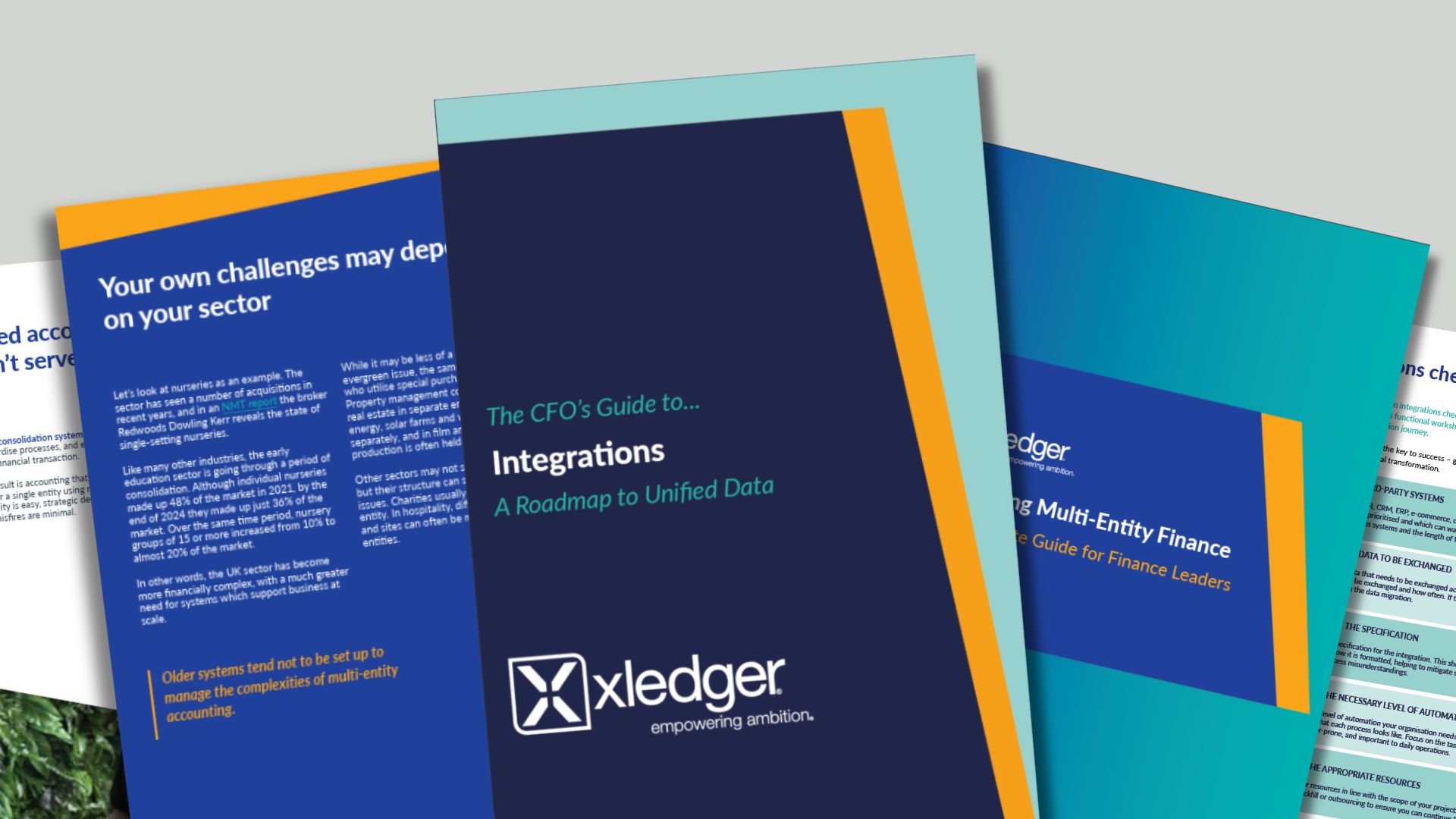
Series: The CFO’s Guide to…
On average businesses stay with the same finance software for 5-7 years, so the pressure is on to get it right when looking to change or invest in new finance software. In this series of guides, we dive into 5 key areas CFOs and finance teams should be clued up on when looking to change accounting systems. We hope you enjoy.
Get in touch
Have any questions on Xledger’s finance software?
Get in touch with one of our dedicated team.
Contact person