Norway
 Sweden
 Finland
 United Kingdom
 Denmark
 United States
Digital transformation projects often focus on implementation, with timelines and go-live dates excluding ongoing developments after these events. Comic Relief’s former Head of Finance, Bex McGann (now Director of Finance at Crisis), shared a different perspective: the real value of change often appears in the years that follow system go-live.

Reflecting on Comic Relief’s journey with Xledger three years after go-live, Bex discussed the drivers behind the project, the charity’s determination for value, and what she would do differently if starting again.
Transformation driven by organisational change
For Comic Relief, the decision to replace its legacy finance system was part of a much broader transformation programme. Bex explained that, after the COVID-19 pandemic, donors and supporters significantly changed how they engaged charities and consumed media.
Comic Relief had historically relied on large television fundraising moments, but audience behaviour was changing. “We relied on, or we still do rely on, a TV moment, and that linear TV viewership was really in decline,” Bex elaborated. “People are watching Netflix. People aren’t flicking on BBC One on a Friday evening. We needed to think about how we show up in the sector as an organisation and how we interact with our supporters.”
These changes to viewership led to several strategic priorities, including,
- Diversifying income streams
- Measuring impact more effectively
- Focusing on becoming a more data-driven organisation.
At the same time, Comic Relief’s finance team was operating on a legacy system without support, which had been in place for approximately 20 years. The system presented a few challenges, outlined below:
- The system was difficult to use.
- The system provider had removed support.
- If the system broke, it was difficult to fix.
The lack of system flexibility, combined with a significant shift in audience engagement, led Comic Relief to choose Xledger as its new finance system, which ultimately went live in 2023.
Read Comic Relief’s case study to discover the technical system deliverables they gained from implementing Xledger.


“We wanted a system that could adapt to strategic requirements in the future, could produce reports that would be useful to the rest of the business (not just finance), and we also wanted to improve data quality, especially for year-end. And what we have now with Xledger is yards ahead of what we had before.”
Bex McGann, Head of Finance
Comic Relief
Defining success before the project began
Before beginning the project, Comic Relief took the time to define what success would look like. The key priority was strong financial controls, with a reduction in manual processing outside of the new system.
Other key objectives were improved efficiency, better connection between finance and the wider business, and a seamless flow of information between finance and operational teams.
Bex explained the thinking behind these objectives: “We don’t want to hold all of the power. We want the organisation to be interacting with finance, to own their own transactions, and have accountability and ownership.”
Overall, Comic Relief’s objectives were:
- Gain stronger financial controls.
- Increase efficiency and data access.
- Improve talent retention and team experience.
What worked better than expected?
Bex highlighted that the finance team has seen the greatest impact since adopting a modern way of working. Using Xledger, “Our finance system has really become the centre of our team. I call it like the glue that holds us together.”
Adding to this, Bex noted that “the team is happier. We have good retention,” showing how the people who became experts during the implementation have been retained, helping to preserve organisational knowledge and improving processes over time.
Comic Relief’s documentation has also improved since the implementation. While end-to-end documentation is valuable in the present, it’s also essential as the finance industry moves towards more intelligent processes. “As we’re now moving to look at [artificial intelligence] AI and agentic AI and what that looks like, we’ve done a lot of that work already,” Bex outlined.
Integrations unlock better visibility
The organisation integrated Xledger with Salesforce, which supports grant management, unlocking greater visibility across the two systems. Comic Relief manages approximately £30 million of grants annually, and before implementation there was limited visibility between grant information and finance data.
Today, grant and commitment information flows between systems automatically. “All of the grants and commitments that you’re putting into Salesforce are feeding through every 24 hours into our finance system,” Bex illustrated. “We’ve got a really good view of our short and long-term creditors, and we can feed that into our cash flow reporting.”
Reflecting on the difference, Bex said, “Now I look back, I just think I can’t believe we used to do all of that without that visibility. […] This is an example of successful digital transformation in the sense that we’ve added value to the organisation. Data is better. It’s cleaner. It’s more accessible.”
The importance of strong controls
Comic Relief has also seen real value in their strengthened governance and control processes, gaining audit trails, clearer segregation of duties, and approval workflows that are built directly into the platform.
For Bex, one of the biggest advantages is the confidence this creates. “I feel really confident that an invoice can’t be approved by the wrong person because the system doesn’t let you do that.” Not only does this control ensure finance is governed properly, but it also increases accountability for budget holders and approvers.

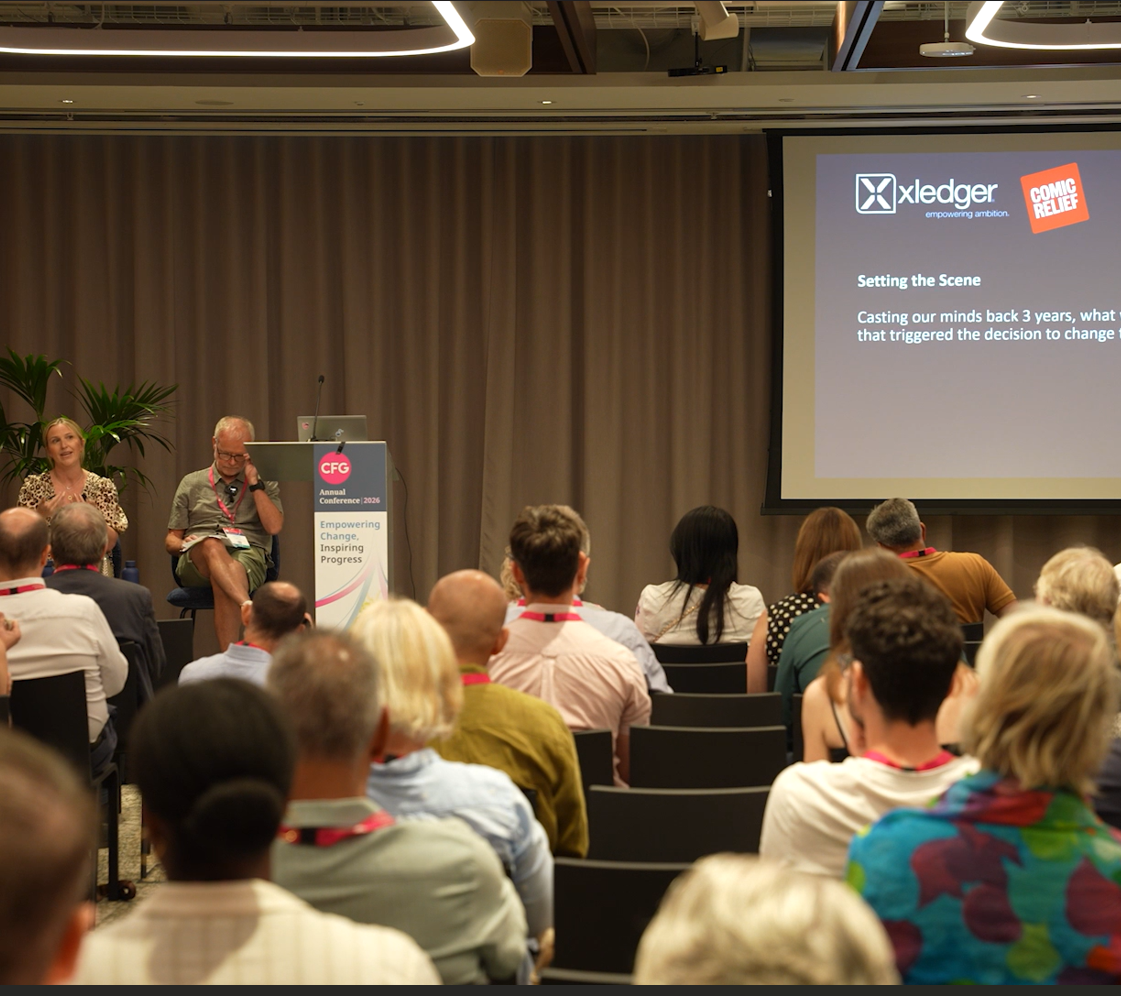
Three Years On: Lessons from Comic Relief’s Digital Transformation
Join Bex McGann (former Head of Finance, Comic Relief, now Director of Finance at Crisis) and Neil Wildy (PM Manager, Xledger) as they bring together real-world perspectives from Comic Relief’s digital transformation project, shared at the Charity Finance Group Annual Conference.

The lesson Comic Relief learned the hard way
While the project delivered significant benefits, Bex was candid about what didn’t go quite as planned. Here, she explains that implementation wasn’t the biggest challenge. Instead, she acknowledges, “we disbanded our project team too early.”
Like many organisations, Comic Relief focused heavily on reaching go-live. “We all knew the go-live date.” But once go-live arrived, attention shifted back to business-as-usual (BAU).
“The big chunkier bit of work is yet to come because post-go-live is how you establish the system in the wider organisation and how you leverage the benefits that the system can deliver.”
As a result, some of the more strategic elements of the transformation, such as advanced reporting, dashboards and automation, didn’t receive the same level of focus, and weren’t fully resourced at the time. “Three years on, we’re almost coming back to that phase two,” Bex explained.
Comic Relief’s key advice
“The one thing that I would do differently is not disbanding the project team [after go-live],” Bex said, also emphasising that digital transformation should never be viewed as a finite project, rather an ongoing journey.
Organisations that dedicate time to evolve success factors and adapt after implementation can adopt newer technologies as they emerge, as they already operate in a strategic, forward-looking mindset.
Key Takeaways
Summarising the project, it’s clear that organisations can undertake a digital transformation process for numerous reasons. For Comic Relief, this experience offers several lessons for charities starting their finance transformation journey:
- Define success beyond the go-live date.
- Use implementation as an opportunity to document end-to-end processes.
- Invest in super users and internal champions.
- Build reporting and dashboard capability into long-term planning.
- Keep project momentum going after implementation.
- Recognise that digital transformation is an ongoing journey, not a one-time event.
Most importantly, don’t assume the project is finished once the system goes live. As Comic Relief discovered, some of the most valuable benefits are realised in the years that follow.
Get in touch with our dedicated consultants, all from accounting backgrounds, to learn how Xledger can help transform the way your charity manages its finances.
Customer story
Comic Relief
Comic Relief started their Journey with Xledger in 2023, moving from a system that was 20 years old to a modern system that could meet their needs.
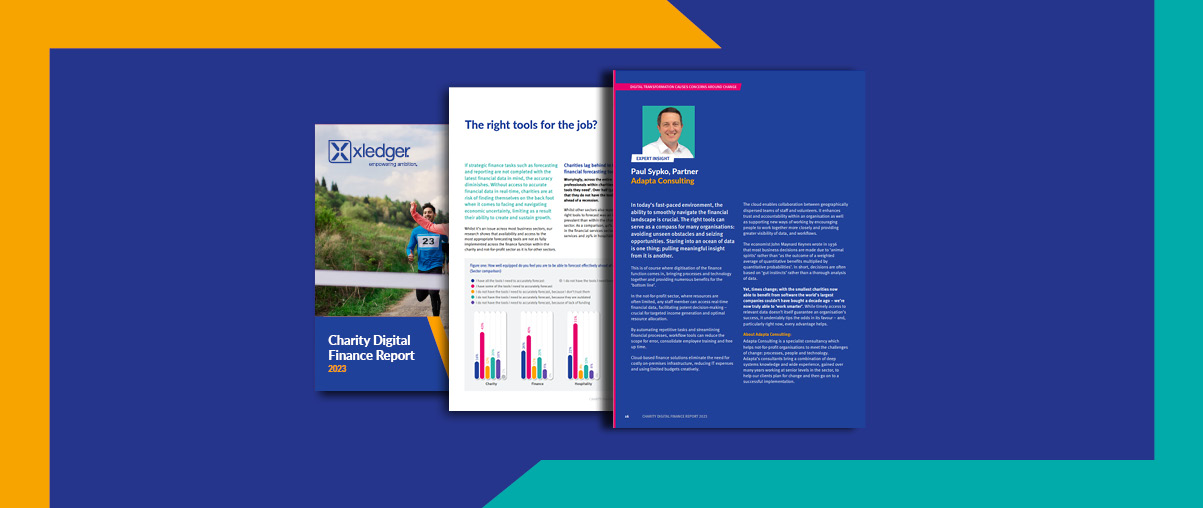
Guide
Charity Digital Finance Report
Key points:
- What is preventing charities from unlocking their needs for better financial reporting?
- What benefits do charities who have digitally transformed see?
- What support do finance teams need in their journey?

Article
Choosing the Best Accounting Software for Charities
Control funds. Simplify SORP compliance. Further your charity’s mission.
Get in touch
Have any questions on Xledger’s finance software?
Get in touch with one of our dedicated team.
Contact person