 Norway
 Sweden
 Finland
 United Kingdom
 Denmark
 United States
In a sector where income is unpredictable and dependent on seasonal events, tracking income is critical. We explore how organisations can manage and analyse their funds, and forecast accurately for upcoming seasons with accounting software for entertainment industry.

If your entertainment organisation is struggling with financial visibility, forecasting, and income and expenditure tracking, get in touch with one of our dedicated team members. Or, visit our market page to discover how Xledger helps businesses like yours with real-time financial reporting and forecasting tools.
Who makes financial decisions, and why are they so complex?
For many arts, culture, hospitality, museums, galleries, and performing arts organisations, income conversations can be complex. This complexity will increase particularly if the business is new, the event varies from the organisation’s usual ones, or the commercial audience is underdeveloped.
In most cases, the following people and teams are involved in funding decisions:
- Finance leaders (chief finance officers, finance directors, finance controllers, finance managers)
- C-Suite executives (chief executive officers, operations directors, chief digital officers, director of collections)
- Boards of directors and boards of trustees
- Investors or donors
- Local governing bodies
In for-profit entertainment organisations, funding is a central part of a finance leader’s role. Collaborating with other C-Suite executives and investors, finance leaders need direct financial oversight of investments and cash flow to ensure that funds are controlled appropriately. Because funds are dependent on commercial success, funding decisions focus on profitability, return on investment (ROI), and risk.
However, not-for-profit organisations operate within tighter financial demands and may find funding decisions more complex. For not-for-profit entertainment organisations, finance decisions are decentralised and require input from stakeholders, boards of trustees, grant providers, and donors. Funding is allocated depending on whether the fund is restricted or unrestricted, which limits finance leaders’ flexibility in responding to rapidly changing circumstances.
Despite these differences, funding remains the foundation for both arms of the entertainment industry. So why do so many organisations struggle when it comes to forecasting their funds? And how can they improve?
How do modern forecasting tools increase accuracy?
Real-time financial oversight is key to accurate forecasting. Without it, entertainment organisations are forced to base their forecasts on outdated information, increasing the risks of poorly planned events, inaccurate budgets, and a decline in long-term financial health.
Modern, cloud-based accounting software enables finance leaders to forecast with more accuracy, using multi-dimensional analysis to drill down into projects, cost centres, individuals, and various time periods for deeper insight. By continuously comparing forecasted and actual revenues, entertainment companies can respond to changes with more confidence and precision.
Automated accounting solutions help simplify the process of forecasting by eliminating manual tasks and spreadsheet-based reporting. This saves time, so finance can focus on analysis rather than administration and improve budgeting and production accounting.
How to access a single source of truth for income tracking
Integrating your existing ticketing or customer relationship management systems with your finance system provides entertainment finance teams with a central hub of data. With one version of the truth, finance leaders access real-time, accurate insights into various projects and events.
When financial data is delayed or fragmented, both commercial and not-for-profit organisations struggle to make timely, accurate funding decisions. And, data that is difficult to interpret increases financial risk and limits long-term sustainability.
Systems integration influences a number of operational areas, including ticketing, project management, payroll, procurement, and fund allocation. Here are a few examples that show how integration can help provide a single source of truth to your organisation:
- Ticketing system & finance system integration: Connecting these systems allows organisations to instantly identify how much money has been generated or saved on a specific show.
- Payroll accounting system & finance system integration: Labour cost is one of the largest expenses for entertainment organisations, and this integration reduces manual input, provides a real-time view of labour costs, and ensures forecasts reflect real-time staffing costs.
The effects of modern finance tools on business-wide operations
By connecting finance and wider business operations, finance teams benefit from reduced manual data entry, more efficient daily tasks — such as expense management — and less time-consuming mundane queries from non-finance users.
Similarly, non-finance users can answer their own budgeting and spending queries through a user-friendly interface and self-serve dashboards that connect directly to their bank feeds. As a result, non-finance users have access to immediate information and aren’t waiting for finance to provide them with data that may be outdated.
Budget and forecast with confidence
Cloud-based accounting software empowers entertainment finance teams with real-time data to inform budgets and forecasting decisions. Powerful reporting tools, resource planning functionality, and the ability to report against three different budgets and forecasts in one single report enable finance teams to support the long-term financial management of their entertainment organisation.
Book your free demo today and discover how Xledger empowers the entertainment industry with automation, insight, and scalability.
Get in touch
Have any questions on Xledger’s finance software?
Get in touch with one of our dedicated team.
Contact person

Frequently Asked Questions
Consolidated entertainment accounting software centralises budgets, historical data, and financial assumptions, making it easier to create transparent investor-ready packs and boosting financial credibility.
Entertainment projects often involve irregular or deferred income streams and unpredictable attendance, which cause revenue fluctuations. Forecasting must therefore account for multiple revenue types, including ticketing, streaming, licensing, and merchandise, making the process highly complex.
Automated software captures revenue data from multiple sources, like a ticketing system, for example, and consolidates the data into a single view within your finance system. Entertainment finance teams can see real-time performance across projects and gain faster insights for marketing and distribution decisions.
Guide
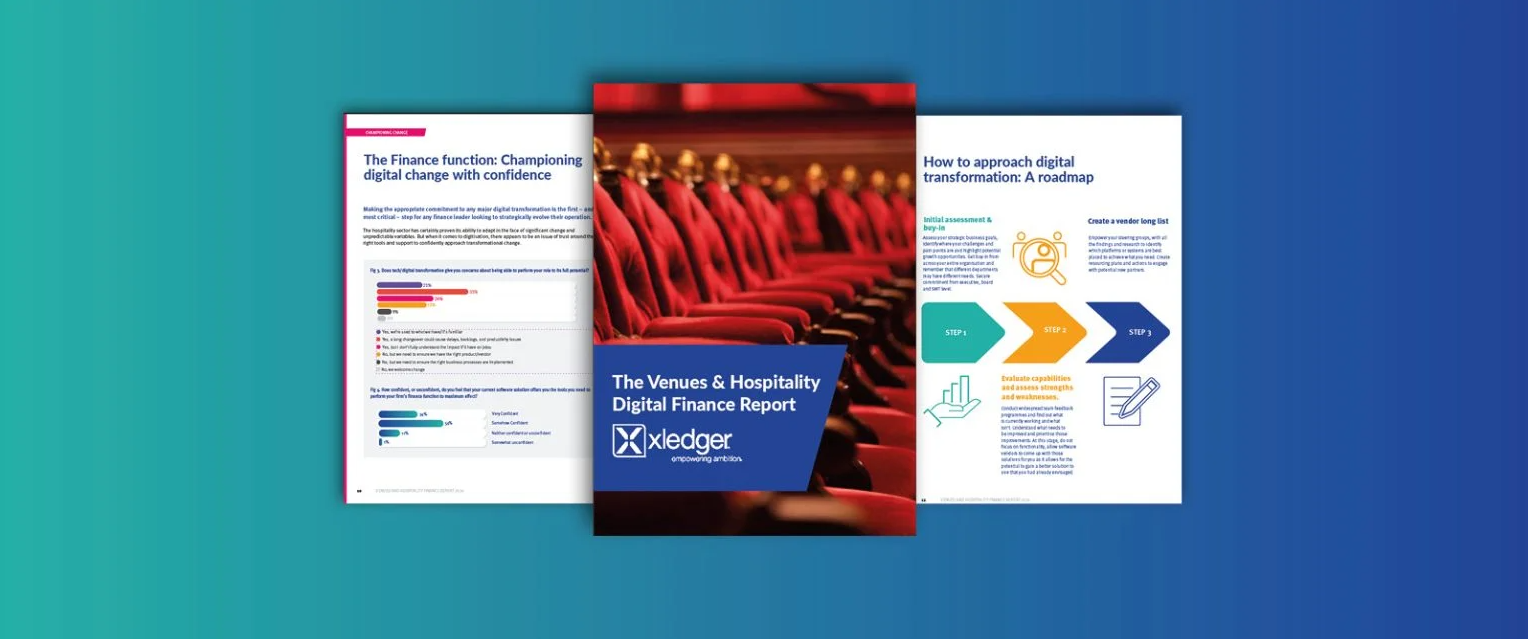
The Venues and Hospitality Digital Finance Report
Key points:
- What’s holding the sector back from completing its full digital transformation journey?
- How to effectively approach a digital transformation project and where to start
- How finance leaders can strategically evolve their organisation with future focus

Customer story
The Roundhouse
To align their financial processes with their broader organisational needs, Roundhouse sought a modern and flexible finance system.

Article
The Importance of Integrated Systems for Arts and Culture Organisations
For a business in the Arts and Culture sector there are multiple sources of income, outgoings, and ways to collect data. All this information is valuable to the business, so it is incredibly important to have systems that communicate effectively, and your finance system is no exception.