 United States
 Norge
Norge Sverige
 Suomi
Suomi UK
UK Danmark
Digi-tech influencers, The Digital Disruptors, and Laura Jolly, Principal Solutions Consultant at Xledger, discussed the evolution of finance functions and the need for accounting automation. Read on to learn how hybridisation is paving the way for a new accountancy age.

The traditional internal accounting role as we know it is dying. Those in the accounting and finance world will be all too familiar with the shortage of accounting talent. Not only has there been a drastic reduction in emerging talent, but organisations are also experiencing retainment challenges.
Book a free demo today to learn how our accounting automation software can mitigate burnout and streamline demotivating accounting tasks. Or, click here to learn how our accounting software can benefit your organisation’s financial management.
In 2024, the CFO Talent Pulse Survey stated that 83% of finance leaders reported an accounting talent shortage, with 10% of these respondents stating that the shortage is getting worse year on year. [1] Another report showed a 37% decrease in CPA exam candidates since 2016. [2] Without the next generation of in-house accountants, the concept of a finance function will need to evolve, to adapt and keep pace with changing professional expectations.
What is causing retainment challenges in the accounting profession?
Talent retainment difficulties are not solely due to salary. Competitive salary is registered as the least influential factor for attracting new talent. On the other hand, an ICAEW-affiliate report cited that 56% of U.K. accountants suffer long working hours, stress, and burnout. [3]
It’s no surprise, then, that the lack of new talent in the profession is leading to higher workloads and burnout for those holding down the accounting fort.
Ultimately, retention issues are spiralling into a vicious circle; a lack of new talent means long hours and high workloads for current accountants. Current accountants are reaching burnout and leaving the profession. No new talent is coming in to bolster the numbers leaving the profession. Etcetera, etcetera.
On the other hand, the CFO Survey [1] recorded that positive company culture and work-life balance were the top talent attractions. To understand why professional attitudes have changed, we must first understand the structures available to promote work-life balance and positive company culture. The primary structure: hybrid finance functions that add value by leveraging accounting automation technology.
Leveraging the best accounting software to gain insight
Accounting software saves time, and finance functions can never have enough time. Xledger fills the space where the skills gap exists; companies that leverage automation to reduce manual effort, task duplication, and time-consuming admin can increase profit margins and value-added resources.
Consequently, businesses run as efficiently as possible, and accountants and finance leaders streamline how they process transactions and access insights across multiple companies or customers. Clients with 1,000 payments a week have gone from 7 hours of processing in an old system to less than half an hour in Xledger, which is over 90% time-saving.
“Xledger really scales with accountancy practices that are widening their offering, and the in-built multi-entity functionality also works well within a partner domain structure. For example, for AP, you don’t have to switch between each entity, you can sit at the top, cut out the moving around, and process for all your clients.”
Laura Jolly, Principal Solutions Consultant
Xledger
Xledger is a highly automated accounting software built for numerous transactional tasks and flexible reporting, two important requirements for mid-market businesses. Essentially, this means Xledger streamlines workflow and allows users to slice and dice data from every possible angle.
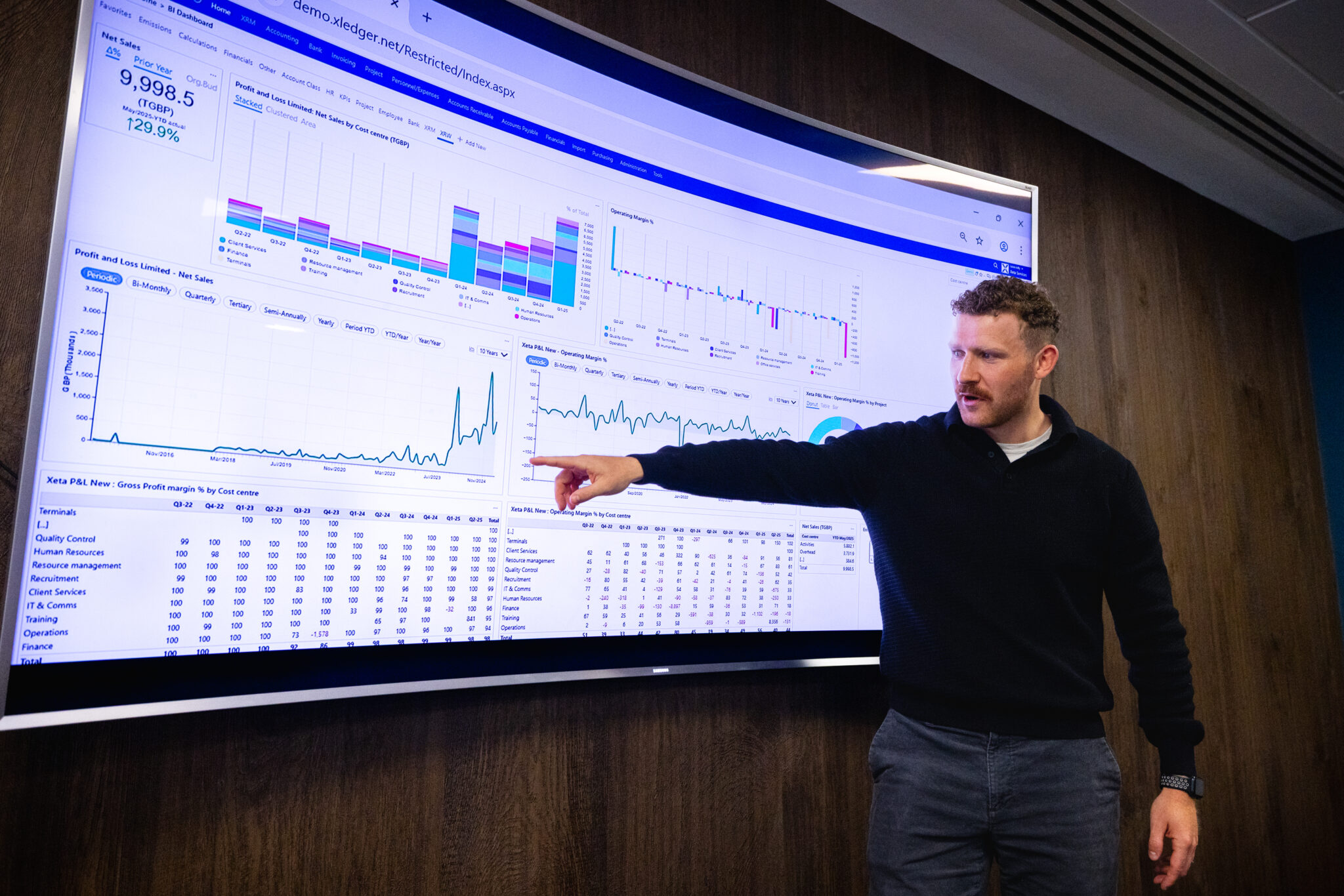
Xledger’s flexibility meets the demands of mid-market companies by providing multi-purpose inquiry screens and real-time dashboards that provide users with a 360° understanding of their business’s health.
For example, finance functions can cut reports such as standard Profit & Loss statements in a variety of ways — be it between budget holders, projects, employees, contributions, or any other dimensions.
Added to this, the ability to drill down and drill through the data within any report means that understanding the details and scrutinising the reasons behind the stories that the data tells is quick and easy.
Hybrid accountancy functions help to support and scale business
Small business owners typically perform bookkeeping and accounting tasks themselves, and may occasionally partner with local firms to check statutory statements. But, as small businesses grow into the mid-market, this partnership no longer offers the appropriate support that matches the pace of growth.
Often, growing businesses will appoint a finance leader, but will not have the budget or time to employ an in-house finance function. Outsourcing accounting talent is an ideal way to combat this challenge, with 90% of the Talent Pulse survey respondents already outsourcing at least some of their accounting functions. [1]
“Reporting comprehensively across a group of organisations allows you to work in tandem more effectively with an internal finance leader. It gives the opportunity for you to ask, ‘What do you want, what are your current risks, growth targets, and metrics?’”
John Toon, Tech Strategy Lead and Podcast Host
Beever & Struthers and Digital Disruptors
A hybrid finance function promotes partnerships between internal finance professionals and external accountancy firms or financial advisors. This simultaneously fills the accountancy skills gap that many organisations are facing and allows companies to flex and grow. From simple bookkeeping to a more advice-led finance function that adds value, businesses have access to experts who can preemptively leverage technology and automate time-consuming tasks.
Accounting firms that can support clients by offering specialist advice— sector-specific advice, regulation updates, or forecasting knowledge—alongside efficient and automated accounting foster long-lasting, strategic partnerships.
Combat long hours with Xledger
Partners act as partial or whole finance functions for multiple clients. This can bring long working hours and increased accountability. However, there is a solution: Xledger’s accounting automation software streamlines time-consuming tasks.
A 2024 report on accountancy firms found that increased working hours significantly harmed 88% of respondents’ work-life balance. [3] Without efficient software, accountants reach burnout and exhaustion quickly, and may even leave the role. Twinned with a severe decrease in young accountants entering the profession, this jeopardises the whole finance profession.
Partners that leverage automated software can act as budget holders, accounts payable, and cash flow managers simultaneously while having extra time to advise internal finance leaders on forecasting and operations.
“With automation, you’re making life a lot easier for people in terms of keeping on top of financial data, processing financial data, and ensuring accuracy of financial data.”
John Toon, Tech Strategy Lead and Podcast Host
Beever & Struthers and Digital Disruptors
Xledger increases efficiency and alleviates pressure on partners because, with automated approval workflow, accountants can simply validate and send invoices to clients for approval. Here, each client’s account exists in a separate ecosphere—partners can simply switch accounts without data governance risk.
Xledger’s automation reduces manual input, creates time, and provides a positive work-life balance for accountants.
A bright future for partner accountants
Xledger is fundamental to a relationship built on oversight and added value. Accounting automation creates extra time for you to advise finance leaders on what their business needs to excel, whether that includes different dashboards, various automation features, or a redirection of funds.
Hybrid partnerships, like those in accountancy firms or partner firms, put an end to transactional relationships. In turn, they create anticipatory, flexible, and value-add roles that extend out of internal finance functions.
To learn how Xledger can support your accountancy practice, get in touch with our Partner Manager, William Doyle-Crisp.
References
[1] CFO Pulse Survey (2024), Finance & Accounting Talent Market Outlook
[2] Sam Mahamudul (2025), Addressing the CPA Shortage with International Talent, The CPA Journal
[3] AdvanceTrack, Smithink (2024), Accounting Talent Index, Advancetrack.com

Webinar
The Future Accountant
This webinar covers:
- Why accountants must strive for a live consolidated view of their clients’ data
- How automation can lead the way for more strategic work
- The importance of error-free data in a digital world
- Looking ahead: the future of accountancy and key insights for 2022

Article
How to Leverage Accounting Automation to Improve Efficiency
Good finance leaders ensure accounting professionals complete necessary processes on schedule and to industry standards. Great finance leaders invest in the correct tools that automate processes and allow accounting professionals to add value through reports, analysis, and commentaries.

Customer story
Accurise
Accurise is an outsourcing accounting organisation specialising in management accounts, bookkeeping, businesses information and support.
Get in touch
Speak to one of our dedicated team members for more information on how Xledger can support your business.
Contact person


Who we work with
Xledger’s finance software solution is designed for mid-market to large enterprises. We work with organisations in many sectors and with our flexible solution we can support those sectors with specific needs.