 United States
 Norge
Norge Sverige
 Suomi
Suomi UK
UK Danmark
The energy sector is evolving rapidly, with finance leaders under increasing pressure to navigate new opportunities and business challenges. We answer three key questions for finance leaders in the energy sector, and learn how CFOs can prepare for smarter, more resilient financial management.

The Energy sector is one of the most technologically forward industries, with renewable and green energy exploration making positive daily changes to the way we live. However, professionals in the sector now face challenges from limited data visibility and late adoption of modern technology.
Data from the Offshore Energy Data & Digital Maturity Survey shows that 40% of energy companies believe a lack of time to adopt new technology is a top business challenge. [1] Respondents from a Grant Thornton survey also feel the sector is burdened with inefficient operations, with 40% voting this as a top business challenge. [2]
Despite these challenges, optimism prevails in the sector. For instance, 42% of respondents plan to implement true-cloud ERP software within the next few years [2], indicating a strong momentum as energy finance leaders increasingly discuss digital transformation and data strategy.
But what are the important questions to answer during these discussions? And how can energy finance leaders avoid investing in software with inefficient workflows? We dive into the three key questions below.
Ready to lead the charge towards digital transformation? Book your free demo today and learn how Xledger can support your energy company and its various Special Purpose Vehicles (SPVs).
Question 1: What technology can I use to support data maturity and analysis?
Automated reporting and self-serve true-cloud software are the most effective and scalable methods of supporting data maturity. According to the Offshore Energy Data & Digital Maturity Survey, energy companies lack cutting-edge data visualisation solutions and are still using legacy software. [1]
It’s clear that without robust data visualisation tools, it is almost impossible for companies to reach data maturity. However, a finance system like Xledger that integrates with powerful data analysis tools can propel growing energy companies toward data maturity.
The survey’s respondents believe the following four software types are highest on their investment list: [1]
- Automated reporting and self-serve software: Organisations can deliver reports and insights from data in immediate and accessible ways. Budget holders can self-serve data to optimise the software for their own role, placing data in the most appropriate hands.
- Geographic information systems (GIS): Energy companies can analyse and plan geographical patterns to aid engineering, and data helps to plot the longevity of a farm or exploration.
- True-cloud SaaS: Energy finance teams and the wider business benefit from real-time data capture, high levels of automation and integration that streamlines financial management.
- Mobile connectivity: Portable technologies, such as headphones and work phones, and facilitating technology, including fibre connectivity, ensure communication is always possible for all energy staff, regardless of distance.
GIS and mobile connectivity are already prevalent within the sector, providing deep analysis and connectivity for companies. So why are so many companies yet to adopt a highly automated true-cloud system?
Survey respondents indicate that data strategies are less understood compared to technology strategies, suggesting that, without clarity on how access to deep data analysis can benefit them, energy finance leaders are unaware of what they are missing.
Xledger’s highly automated, multi-entity finance software provides real-time consolidation and instant oversight of the whole group’s financial position.
“The wind power projects are gathered in different legal entities, which means that the quick and efficient Group management in Xledger saves us a lot of time. One example is that the CEO can log on to the group level, where all the certificates are collected in a list regardless of the company.”
Sofie Karlsson, Group Controller
Arise
Question 2: How can I encourage earlier collaboration between finance and engineering?
Early collaboration between finance and engineering begins in the initial planning stages of developing a new SPV. The vehicle for foundational collaboration, in this instance and many others, is energy accounting software.
The Finance Low-Carbon Infrastructure report emphasises the relationship between finance and engineering as one that is crucial to risk management and SVP development. [3] Finance leaders who promote this see better long-term financials as risk is outlined at the project planning stage.
A Power Engineering article states:
“Engineers and finance need to work together to ensure the company’s technical procedures and courses of action are pre-approved so that everyone is on the same page the moment that something goes wrong.” [4]
Of course, cross-department collaboration is necessary in all businesses in all sectors, but the potential risk that energy companies face when creating new SPVs is substantial. In light of the potential, risk communication between finance and engineering is easier with real-time reporting capabilities.
In Xledger, engineering and finance leaders can forecast years into the future, accounting for risk and regularly reevaluating the numbers to ensure complete cost control.
With modern ERP technology, leaders can proactively share data, manage expectations, and set realistic financial parametres, all of which lead to effective collaboration and operational efficiency.
“We chose Xledger because it offered us the functionality for the business now, and tomorrow. It allows us to consolidate multiple entities in multiple currencies quickly and easily.”
Paul Gilmore, Vice President/Financial Controller
Cornish Lithium
Question 3: Does my energy company need to integrate finance and business software?
Yes, energy companies should integrate their finance and energy management software (EMS). Not only does this facilitate seamless data transfer, but it also eliminates time-consuming tasks and patchwork data siloes, giving leaders access to a single source of truth.
With all the data they need in front of them, CFOs can pitch new projects to investors without needing to manually export data from one spreadsheet, import it into a legacy system, and attempt to report on the outdated data. Regardless of a company’s structure — a few large entities or a portfolio of several smaller entities — finance leaders with integrated systems benefit from confident cost control and accurate data analysis.
The Offshore Energy Data & Digital Maturity Survey finds that data access is a large concern across all organisations, roles, and industries. However, this concern is eliminated with system integrations.
Instead, energy finance leaders can leverage integrated systems to ensure:
- Appropriate users can access accurate data.
- Leaders can leverage BI dashboards when presenting to investors.
- Various departments (risk, engineering, exploration) can collaborate at all stages of a project.
- Key stakeholders are confident about where their money is being spent due to real-time reporting capabilities.
Putting energy into digital and data strategies
With 50% of the surveyed energy market noting that current workforce knowledge and skills are a top 5 barrier [1], it’s no wonder that the energy sector is late to adopt digital and data modernisation projects.
Xledger understands that learning and development are essential to professional development, and isn’t limited to one task or one role. Xledger super-users can learn how to optimise the software by using Equip, our virtual learning system.
Our customers pay no additional SaaS support fees and have access to expert accountancy-trained implementation consultants. Contact our dedicated team to learn how we can support your energy company in its digital and data transformation.
References
[1] UK, E. (2023), Offshore Energy Data & Digital Maturity Survey 2023 | Vimeo.
[2] Grant Thornton survey (2024), Energy CFOs are confident, yet operations and funding challenges persist | Grant Thornton.
[3] ICE (2022), Financing Low-Carbon Infrastructure | ice.org.uk.
[4] Content, E. (2015), 5 Ways Engineers Can Improve Their Relationship with Finance | Power Engineering.

Customer story
Cornish Lithium
Founded in 2016, Cornish Lithium is an innovative mineral explorations and development company committed to securing a sustainable, ethical and environmentally responsible lithium supply for the UK.
Article
Can Energy Accounting Software Create Efficient Workflows?
The Energy sector relies heavily on group consolidation and real-time insights into farms, projects, and departments to understand individual and group-wide financials. We unpack how multi-entity energy groups can manage workflows to ensure this data is accurate and accessible.
Guide
Mastering Multi-Entity Finance
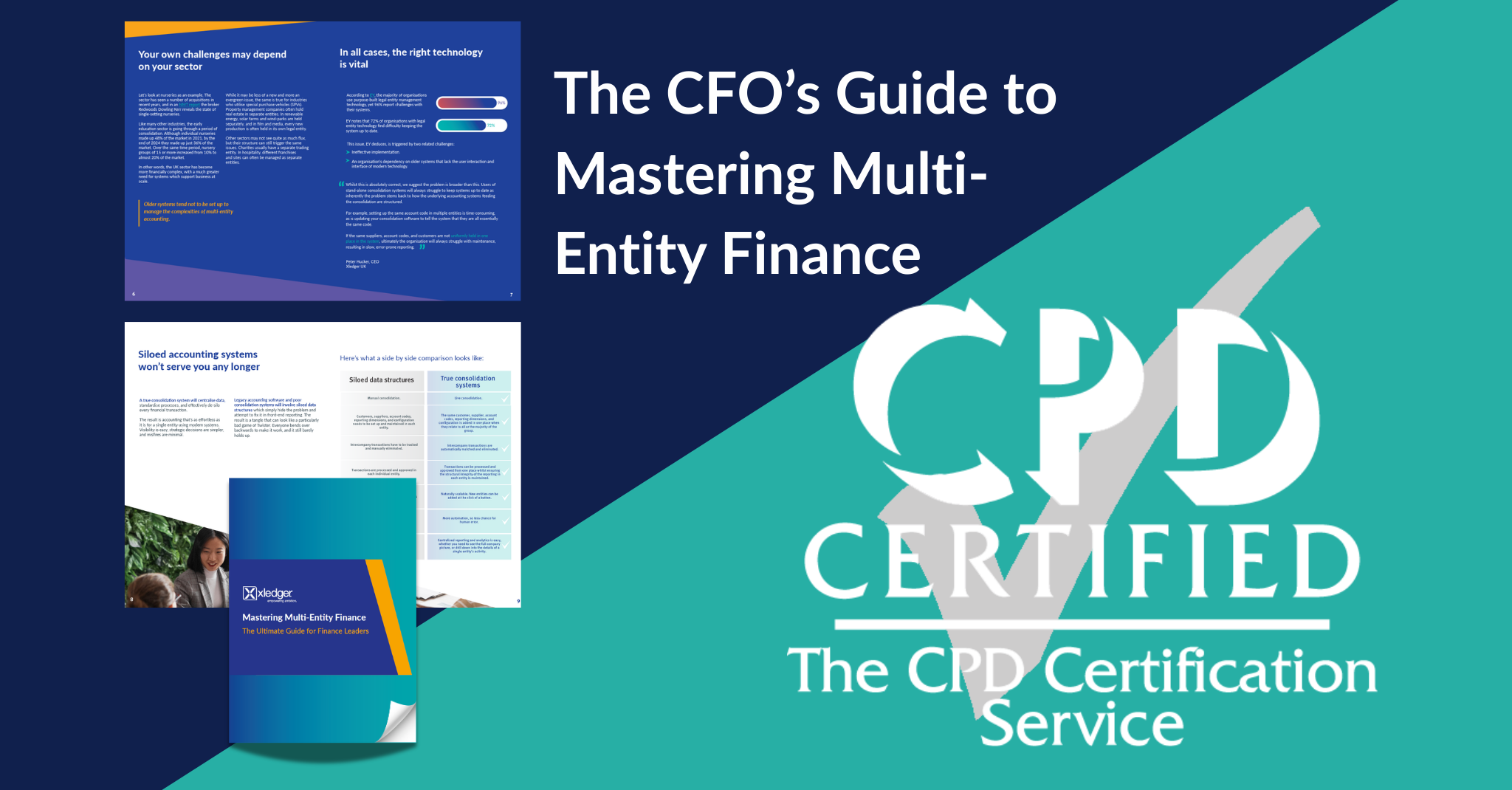
Welcome to Xledger’s CPD-Certified guide.
Are you a finance leader of an expanding business with multiple entities?
Our guide to Mastering Multi-Entity Finance explores the challenges faced when working with a multi-stranded business, the pitfalls of using legacy systems, and how a centralised hub can improve your insight into group financial health.
Complete the learning to receive:
- CPD certificate
- Accompanying learning materials
Get in touch
Have any questions on Xledger’s finance software?
Get in touch with one of our dedicated team.
Contact person