 United States
 Norge
Norge Sverige
 Suomi
Suomi UK
UK Danmark
Finance system integrations are crucial to the efficient running of care home organisations, particularly as they eliminate siloed data. We discuss how care management and finance system integrations help care organisations to monitor budget allocation to ensure high-quality resident care.

Care Homes often suffer from siloed data that demands excessive manual effort to correct and remove from spreadsheets. Simultaneously, business as usual continues — reports are made, audits are completed, forecasting goes ahead, and budget holders learn to manage with very little financial visibility into spending.
There is no doubt that the need for highly integrated care management and finance systems is urgent. A Dell report found that care providers typically spend 60-80% of their IT budgets on maintaining on-premise legacy systems. [1]
Not only is it staggering that many care homes struggle to source funds and keep afloat, as illustrated by the 39% of private adult care providers that closed in 2024 [2]. But this also means that providers are left with, on average, a quarter of their budget for investment and digital transformation.
Contact Xledger to book your free demo or click here to learn how our accounting software for Care Homes can benefit your financial management.
5 benefits of integration for the Care sector
There are many reasons to integrate your business and finance systems, all of which revolve around better access to data and informed decision-making, as a result. The Care sector is no different; it relies on these factors to operate effectively and compliantly.
Finance and care management systems must work together — only then can finance leaders gain true oversight of an organisation’s position. Research in the Journal of Education and Finance Review states:
“Some [finance] models place more emphasis on cost containment, while others place more emphasis on patient-centred care and quality improvement. In order to guarantee that healthcare finance systems support both clinical efficacy and financial efficiency, these priorities must be balanced.” [3]
With clinical efficacy and financial efficiency in mind, we explore five ways software integrations benefit care home organisations.
1. Better flow of data across disparate systems
Disconnected systems are a devastating obstacle when operating a multi-site care home organisation. They cause data siloes, invoicing and billing delays, and lead to duplicated data that scrambles decision-making.
Integrated systems offer a smooth alternative. By integrating care management and finance systems, multi-site care homes ensure that their business data is stored in a single system — a single source of truth.
This centralised data hub seamlessly shares real-time data to provide you with the insights you need. This not only reduces the risk of errors but also frees up time for your teams to perform value-adding analysis and support to key stakeholders.
2. Reduced costs and increased cost control
Cost control is often a stumbling block that catches business leaders out across all sectors. Excessive system maintenance costs can be even more detrimental when restricted funds don’t cover digital transformation or technological upkeep.
It’s no wonder, then, that with 60%-80% of IT budgets spent on maintenance of disconnected systems, care home organisations are left with very little time, money, and human resources to enact digital transformation. [1] In addition to a lack of budgets, Found CRM research shows that the Care Home sector loses £11,000 per day due to paper wastage of paper records. [4]
With a digital system, this number decreases dramatically — not to mention the elimination of lost paper records, unreadable handwriting, or systems that don’t speak to each other.
Xledger’s true-cloud finance solution ensures that paper wastage, bolt-on functionality, and clunky legacy software are a thing of the past. Not only is there no update fee, as all updates are automatically rolled out free of charge, but back-office finance functions can also leverage advanced automation, system integrations, and real-time reporting capabilities to produce value-added finance support.
3. Streamlined financial planning
Whether your care home organisation is for-profit or not-for-profit, financial planning is crucial to staying afloat. When data from disconnected systems is needed for strategic management reports or donor meetings, finance teams have to spend excessive effort collating, reporting, and analysing this data.
Despite this effort, the data becomes outdated as soon as it’s pulled for reporting. However, with integrated business systems, financial planning is streamlined. Finance teams can pull up reports that link resident costs to specific care services, for example, with just a few clicks, providing complete visibility into individual homes, departmental budgets, and group spending.
Finance leaders then have the tools to create proactive long-term plans (rather than reactive short-term ones) that focus on financial sustainability and quality resident care.
4. Improved resident and family care
A care home’s primary mission is to provide high-quality support to people in need. Achieving this requires more than just compassionate care; it depends on efficient financial management.
When invoicing, billing, budgeting, and forecasting are handled effectively within a unified system, key stakeholders can focus their time on strategically planning the best way to provide premium care. The alternative is a disruptive finance system that creates delays and errors in the invoices of vulnerable residents.
Care home organisations can reduce these obstacles by adopting highly automated finance software to streamline processes and give staff, residents, and families complete peace of mind.
5. Future-proofed software that aids scalability
The Care Home sector is already subject to stringent reporting and auditing regulations, and, as healthcare develops and technology evolves, this will only increase. Accessing the tools to meet updated reporting requirements or to adapt to industry changes could make or break an organisation.
Care homes that leverage Xledger’s true-cloud finance software can confidently keep pace with industry demands. Xledger’s open API makes integrating with care management or billing systems quick and painless.
Instead of outdated tools or bolted-on functionality, benefit from a truly scalable solution that grows with you, no matter what tools you need.
Integrate with ease with Xledger’s in-house integration consultants
Xledger’s seamless integration offerings ensure that your finance team always has the right tools, whether that is year-end reporting, auditing and compliance, analysing cost per bed data, or any other task at hand.
Our expert in-house integration consultants work with care organisations to scope out requirements, ensuring your software integration works efficiently for your business. With Xledger, you can eliminate time-consuming manual tasks and create space for your team to provide value-adding analysis, ultimately leading to better resident well-being.
Contact our dedicated team today to begin your care management and finance system integration.
Get in touch
Speak to one of our dedicated team members for more information on how Xledger can support your business.
Contact person


Market
Care
Gain future-proof financial control with Xledger’s finance software for care homes and hospices.
Whitepaper
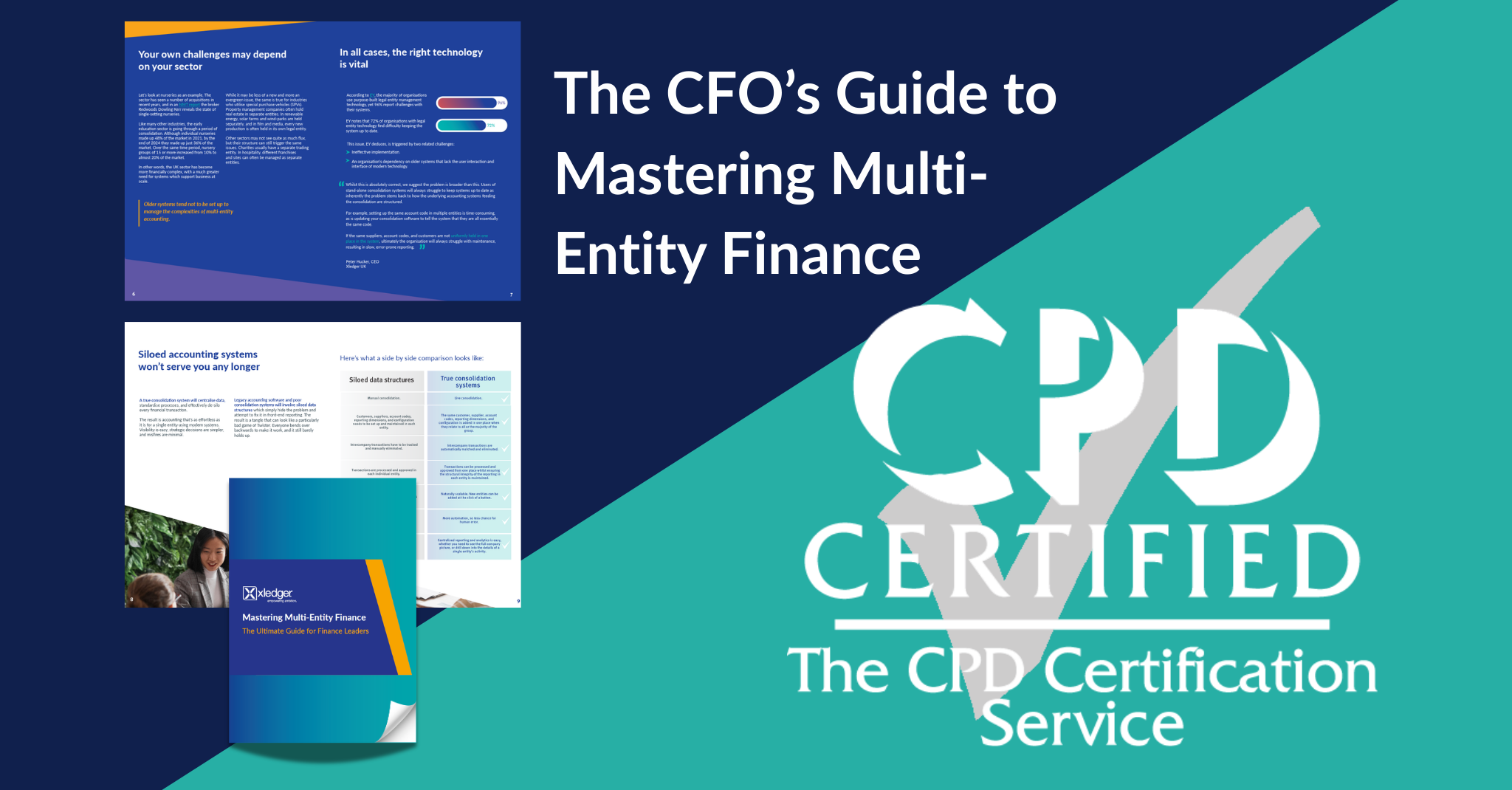
Mastering Multi-Entity Finance
Welcome to Xledger’s CPD-Certified guide.
Are you a finance leader of an expanding business with multiple entities?
Our guide to Mastering Multi-Entity Finance explores the challenges faced when working with a multi-stranded business, the pitfalls of using legacy systems, and how a centralised hub can improve your insight into group financial health.
Complete the learning to receive:
- CPD certificate
- Accompanying learning materials
Webinar
The Xledger Podcast: Scoping and Implementing a Finance System Part 1
Welcome to the Xledger Podcast, a CPD-Certified series focusing on all sectors.
In part one of this two-part series, our team of experts from Xledger explore the scoping and implementation of a new finance system featuring Tim Wright (Operations Director), Zheng Zeng (Consulting & Support Manager), Ana Rodrigues (Project Manager), and Robb Webb (Senior Business Development Manager). Learn about their insights and experiences from working on finance transformation projects.
Complete the learning to receive:
- CPD certificate
- Transcript
- Accompanying learning materials
Do you want to see Xledger in action?
Fill out the form and one of our experts will be in touch to find out more about your needs and how we can help your organisation.


Hospice and Care Home Accounting Software
Hospice and care home organisations often operate across complex structures spanning multiple locations. As such, these organisations struggle with financial accuracy, visibility, and control, as well as duplicating work across these disparate locations.
Xledger is a true cloud-based hospice and care home accounting system that offers real-time insight across your whole organisation.