Norway
 Sweden
 Finland
 United Kingdom
 Denmark
 United States
Conversations around artificial intelligence are everywhere in the finance and technology sectors, and for good reasons. However, through our conversations with finance leaders, it’s clear that avoiding gimmicks and adopting practical artificial intelligence (AI) is the top challenge to navigate.

Alex Vaughan, Associate Director, S&W, recently joined Xledger’s experts to discuss the growing trends in accounting and finance industry. The panel explored bank integrations, AI, automation, and cloud necessity, offering insight into what the future of the sector could look like.
The next 12 months of accountancy tech trends will include:
- Greater collaboration between AI and human intelligence
- Stronger behind-the-scenes automation across complex workflows
- Continued growth and adoption of cloud technology
- More efficient bank integrations with key business platforms
- A change to the traditional approach to forecasting
- Increased automation or AI input within core accounting processes
Trend 1: AI with a human touch will trump AI-only working
Key survey data shows that only 12% of respondents described themselves as fully cloud-based, highly automated, and actively exploring AI capabilities.
AI is a persistent trend in all walks of life, but the biggest misconception within the accounting industry is that it will completely replace finance professionals. Discussing this point, Alex emphasised the need for an AI strategy to alleviate worry and help finance teams understand how the new technology will affect their jobs.
A clear strategy helps people to understand how to “make cost and time efficiencies with the AI”, Alex explained. “You can then use your resources that you’ve saved. People can do value-added work. And then there are endless possibilities for your staff to help give you the information that you need.”
Alongside this, understanding how humans and AI can work together is also a growing trend. As data regulations become more stringent, there’s a shift towards verification and factchecking, both in AI and human reconciled data.
One of the most common uses of AI is to query compliance because the technology provides all the references which accountants can then factcheck. This growing confidence is also influenced by users embedding AI into their everyday lives. As more professionals use AI tools outside of work, their trust in the technology grows.
For accountants, exercising caution is key to good practice; although trust in AI may be slightly slower to develop than in other professions, it confirms that finance and accounting professionals remain critical to successful AI usage. Alex offered a simple analogy to help people understand the role of AI and automation: “AI is like a dishwasher. You don’t have to do all the washing up anymore. But you still have to load it and unload it. And there’s some things that are too fragile to go in there, so they still need the human touch.”
Watch our webinar, featuring our partner S&W
This session was hosted alongside our partners at S&W, where we unpack what’s next for UK accountancy tech.
Trend 2: Behind-the-scenes automation will continue to grow
Key survey data shows that 32% of respondents still rely heavily on manual processes and spreadsheets.
One of the strongest use cases today is data analytics. AI can quickly identify unusual transactions or patterns that might otherwise go unnoticed, helping finance teams focus their attention where it matters most.
Sam Dodge, Solutions Manager at Xledger, explored this point further: “I think the key tasks that AI is working well on within systems are the mundane tasks, like fetching data, doing reconciliations, just things that can be very easily automated.”
Echoing Alex’s earlier idea that accountants are necessary parts of every organisation because every client and situation are different, Sam added, “Accountants are very skilled people – they need to be using the data to make decisions, not just finding the data.” This is where the accountant’s judgement, paired with efficient automation, thrives.
Capitalising on behind-the-scenes automation is a long-term trend, with countless organisations diving into digital transformation projects that aim to harness automation and efficiency. For finance professionals, this a huge win: not only will accountants spend less time consolidating data, but they’ll also spend more time completing the compelling accounting tasks, such as analytics, forecasting, and reporting on data in real time.
Trend 3: Cloud technology and system technologies will deliver the biggest wins
Key survey data shows that 56% of respondents have adopted cloud-based systems but continue to depend on manual workarounds.
Despite AI dominating most conversations, the panellist agreed that the most significant progress could come from leveraging cloud-first, connected business systems.
For Alex, cloud technology is a necessity that finance teams should not be without: “It’s such a valuable tool to be able to get real-time information, the ability to have lots of different people using it for whatever they need at the same time with different needs.”
Like AI and automation, this trend is not new. But as on-premises legacy systems continue to become unsupported, cloud-first systems continue to show their worth, allowing finance teams to move away from static reporting cycles, towards more agile decision-making.
Sam also highlighted the value of native bank integrations. By directly integrating finance systems and banking platforms, finance teams can reduce manual processing, improve control, and build a single source of truth for payments and reconciliations.
“I think this is probably the biggest development that I’ve seen outside of AI technologies, just purely for the automation behind it and the extra controls,” Sam remarked. He also outlined the tangible wins that organisations can gain from leveraging native bank integrations: “It frees up your time to do more of the value-adding elements of accounting, especially when it comes to reconciliation and payments. It’s so easy not having to log into your bank all the time to process your payments. Plus, the extra control and automation is extremely effective.”
The future of accounting
Looking ahead to the next 12 months of accountancy trends, the panellists are optimistic that the accounting profession will continue to grow into key advisors, not just administrators.
Forecasting emerged as one of the key areas of accounting most likely to benefit from AI over the coming year, with Alex summarising this shift clearly: “When it comes to forecasting, I think as an accountancy profession, we’re going to stop looking backwards. We’re going to be looking at now and the future – and all this technology is going to really help with that.”
Sam also noted that accounting processes, such as accounts payable and purchase-to-pay, may also see more automation to remove manual work and improve efficiencies.
In any case, the next wave of technology trends will need to work alongside strategy leaders to solve problems: “It’s about reviewing how you’re operating and what you’re trying to achieve and then working backwards from that and to fit it into your overall strategy.”
Summary
Over the next 12 months, organisations that combine AI, automation, and cloud connectivity will be best placed to thrive in a competitive market because their technology will solve problems.
Whether the problems are reconciliation workloads, outdated reporting, or poor financial controls, the task remains the same: creating more time for value-added activities by building a clear technology strategy.
Frequently Asked Questions
AI is currently the most effective tool for automating repetitive administrative tasks, which allows finance professionals to spend more time analysing data and supporting decision-making. Here, collaborative working ensures that data gets from A to B accurately and on time so finance teams can perform value-added tasks.
Current use cases of AI include automating data entry, researching and verifying compliance queries, analysing data, finding information via chatbots, reviewing processes, and identifying data inaccuracies.
Both speakers recommended starting with a clear understanding of the problem being solved. Organisations should identify where inefficiencies exist and define business-wide goals to ensure key stakeholders understand the strategy and buy into the new technology.
The panel suggested that AI can actually help reduce fraud by identifying data anomalies or unusual transactions quicker. However, organisations should ensure that data governance, security, and compliance controls remain a top priority when implementing AI solutions.

Article
5 Processes to Streamline with Automated Accounting Software
It’s not news that accountants are under pressure in their work, but the intensity of that pressure seems to be increasing. This increased pressure has a consequence: one third of accountants stated they make weekly errors due to capacity restraints.
Webinar
The next 12 months in UK accountancy tech: AI, bank integrations, and other key trends
Welcome to Xledger’s CPD-Certified webinar.
In 40 minutes, experts from Xledger and S&W share real-world perspectives on technology adoption and the challenges and opportunities facing the UK accountancy tech landscape, focusing on practical impact to cut through the hype.
You’ll learn where technology is already delivering value, where expectations may need resetting, and how improved connectivity and automation can reshape financial processes. Focus your understanding of innovative accounting technology and cement your learning with a short, multiple-choice knowledge quiz.
Complete the learning to receive:
- CPD certificate
- Accompanying learning materials
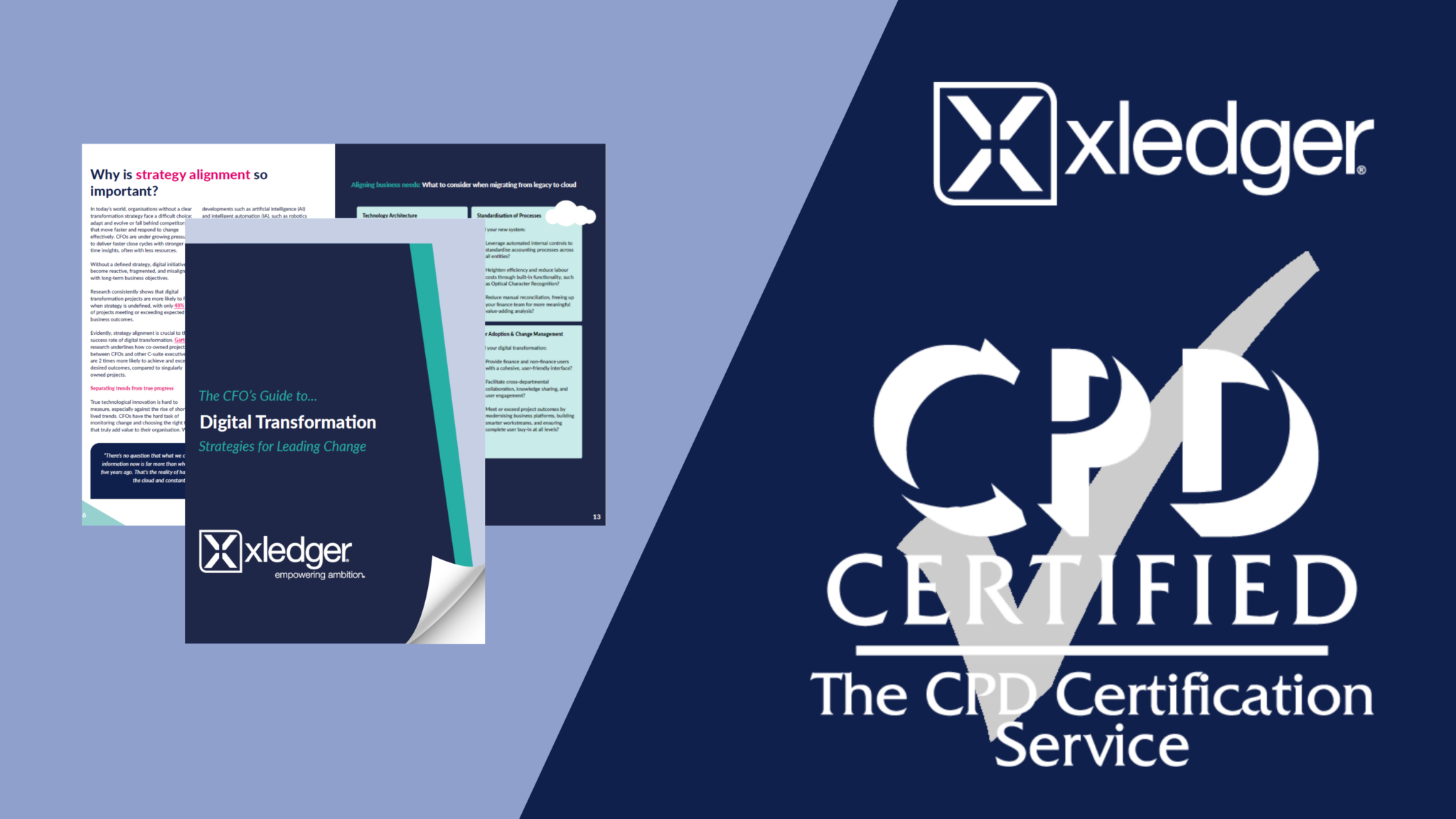
Guide
The CFO’s Guide to Digital Transformation
Welcome to Xledger’s CPD-Certified guide.
Our guide unpacks the risks of digital stagnation and offers key performance indicators (KPIs) that CFOs can use when measuring transformation success. Featuring expert insights, you’ll discover the steps to scoping a new finance system and critical questions to ask when aligning finance and wider business needs.
Complete the learning to receive:
- CPD certificate
- Accompanying learning materials
Get in touch
Have any questions on Xledger’s finance software?
Get in touch with one of our dedicated team.
Contact person