Norway
 Sweden
 Finland
 United Kingdom
 Denmark
 United States
Jamie Allen, CEO and Founder at 4PointZero (Xledger Partner), presented Xledger’s recent webinar, “Centralising Your Operational and Financial Data for Strategic Advantage”. During the webinar, Jamie discussed how a single cloud-based finance platform can eliminate data silos, streamline processes, and deliver a real-time, unified view of organisational performance.

Why do data challenges occur?
Jamie began by highlighting the core problem organisations face as they scale while working with disconnected systems.
Usually, finance teams are disproportionately left with the burden of manual reconciliation, correcting and reinterpreting data that should already be aligned in the system.
The disconnect actively slows down business operations because the different teams may report in different ways across different platforms, leading to confusion and conflicting interpretations of numbers.
Through experience, Jamie explained that fast-growing organisations often suffer the worst data challenges.
- Using manual processes to share data across the business: Human input increases data duplication and errors, and decreases the amount of value-adding tasks finance can perform.
- Different platforms across departments: A lack of business-wide system connection increases the reliance on storing and manipulating data outside of business systems.
- Increasing reliance on spreadsheets: This siloes data, relies on fragile formulas, and makes it difficult to view data in real time.
When connecting business software, Jamie noted, “What we’re trying to create is an integrated or centralised system, so you can visit one system and have confidence that the data is correct and up-to-date.” By connecting systems and therefore removing reconciliation issues, the entire organisation benefits from a comprehensive single source of truth that aids decision-making.
Jamie continued, “If you’re operating two different systems with elements of duplicated data, it encourages departments to work in silo. Operations will look at finance and say, ‘your number is wrong’, and finance will look at operations, and say, ‘no, your number is wrong’.” To counter this tension, a single source of truth ensures everyone is working from the same data, improving decision-making confidence and cross-department collaboration.
Does scale affect data management?
Essentially, yes. Jamie was clear that fast growth can jeopardise data quality. When organisations evolve organically, they often add systems to their digital ecosystem to solve immediate problems. However, as Jamie outlined, this creates long-term challenges.
“Typically, as businesses grow, they will have certain operational systems that they use because there’s a benefit, and it’s potentially not possible to include those within a finance package. For that reason, separate systems support separate functions in smaller businesses. But, when an organisation grows, you need to ask whether it’s possible to move those into your finance system and centralise your data.”
Jamie continued to explain why data challenges happen at scale, noting that smaller data samples are far easier to manipulate than bigger samples. For this reason, organisations may not realise their data is of poor quality until they begin manipulating and reconciling on a large scale. Consequently, process standardisation is key to sustainable growth and strategy.
“If you’re looking to create a scalable way of growing through some level of standardisation, and you have that in your operational tools, you will find it easier to integrate [business systems], because you can create rule-based logic to be able to handle the situations.”
Standardising processes is one of the most significant benefits that businesses gain when centralising financial and operational data in one system. Often, organisations are wary of centralising their data, particularly if they operate on a single ecosystem model. But, through process standardisation (and centralisation), manual input decreases, and data quality improves. Finance teams gain access to a single authoritative data set, one that informs decision-making and real-time analysis.
Contact our dedicated team or explore our features to understand how Xledger can centralise your data and improve decision-making for your organisation.

This webinar was hosted alongside our partner 4PointZero, where we explored how to align operational and finance strategies.
This webinar covers:
- Aligning operational and finance systems to create a single source of truth.
- The benefits and trade‑offs of a centralised system vs an integrated ecosystem.
- Practical ways to reduce manual processes, reconciliation effort and data silos as organisations scale.

How does flexibility block data accuracy?
Jamie continued his discussion, moving from technology blockers to challenges created by people. Growth helps to uncover the weakness of manual processes, but once time-consuming processes are highlighted, it can be difficult to know how to solve them.
One of the most impactful points Jamie made was about flexibility and how it is sometimes detrimental to standardisation. “The enemy of efficiency and standardisation is flexibility”, Jamie stated.
Explaining his reasoning, Jamie suggested that when growing organisations change processes quickly and regularly, like introducing new commercial or bespoke offerings, finance can become inundated with reconciliation, manipulation, and reporting. If finance isn’t armed with automation, it must keep pace with changing operational models through manual effort.
Without knowing it, senior leaders can implement new product offerings that actually inhibit the ability to align finance with operational strategy, thus inhibiting overall growth. Adding new systems during this period masks the issue, and “If you’re not fixing the data in the operational system, you’re simply passing the problem to finance.”
A key solution to this problem is integration. It acts as a spotlight, exposing where manual manipulation or unclear processes are hiding and connecting the systems to create a centralised, single source of truth.
Considerations for a finance implementation project
Jamie answered some audience questions, talking about the challenges and priorities of centralising data and implementing a new finance system.
What is the hardest part of trying to bring all data into one system?
“Typically, I find the hardest part is twofold. The biggest barrier to change often is humans, whether we like to admit it or not. If you have people who are the custodians of certain systems, asking them to move is rocking their boat a little bit.
So, getting stakeholder buy-in and confidence that everything is going to work is critical, and you need to involve them in the process.
And then the second challenge, which is equal, is the quality of the data that you are moving across. We see it in a lot of circumstances; we meet a business, they say, “yes, yes, yes, we want to integrate”, and then we actually look at the data, and it doesn’t add up. So, you need to ensure that the data that you’re producing is what it should be.”
What should you prioritise first?
“I would always calculate priorities on the 80–20 rule in terms of what is costing you most time, because the basis of improving things in finance is that it’s a journey. It’s never a magic wand – it’s about incremental gains, right?
You’ll always want to prioritise things that you’re going to get the most value from, whether that’s from reducing time spent processing or better data or whatever the challenge.”
Tangible benefits for your organisation
The discussion reinforced the idea that aligning finance and operational systems is not just a finance project; it’s a strategic, business-wide transformation that must be led by change-makers. For organisations to succeed, they must:
- Confront data quality issues openly and collaboratively
- Involve internal stakeholders early to build trust
- Understand how change management affects stakeholder attitudes to data management
- Focus on the areas of financial management that deliver the greatest value
Creating a single authoritative data set that finance, operations, and the wider business can work from is critical to sustainable growth. Without consistent data, organisations become siloed, working from different data sets to make different, misaligned decisions.
Get in touch with the dedicated team at Xledger or 4PointZero can help centralise your finances and increase financial control.

Article
Why Live Consolidation Matters for Multi‑Entity Finance Teams
For many growing organisations, multi‑entity structures emerge gradually when a new subsidiary is formed, the company expands across borders, or a charitable trading arm launches. However, when these structures begin to multiply, finance teams often find themselves working within outdated systems that were never designed to manage this level of complexity.
Webinar
Modern Finance Made Simple: The Case for Moving Beyond Legacy Systems
Welcome to Xledger’s CPD-Certified webinar.
In 30 minutes, experts from Xledger and Millennium Consulting unpack the main blockers that prevent organisations from migrating to modern finance software, including risk perceptions, integrations, data quality, and change management.
You’ll learn the benefits of cloud technology and automation and hear expert insights into how carefully considered system change can build resilience in finance teams. Focus your understanding of system modernisation and cement your learning with a short, multiple-choice knowledge quiz.
Complete the learning to receive:
- CPD certificate
- Accompanying learning materials
Guide
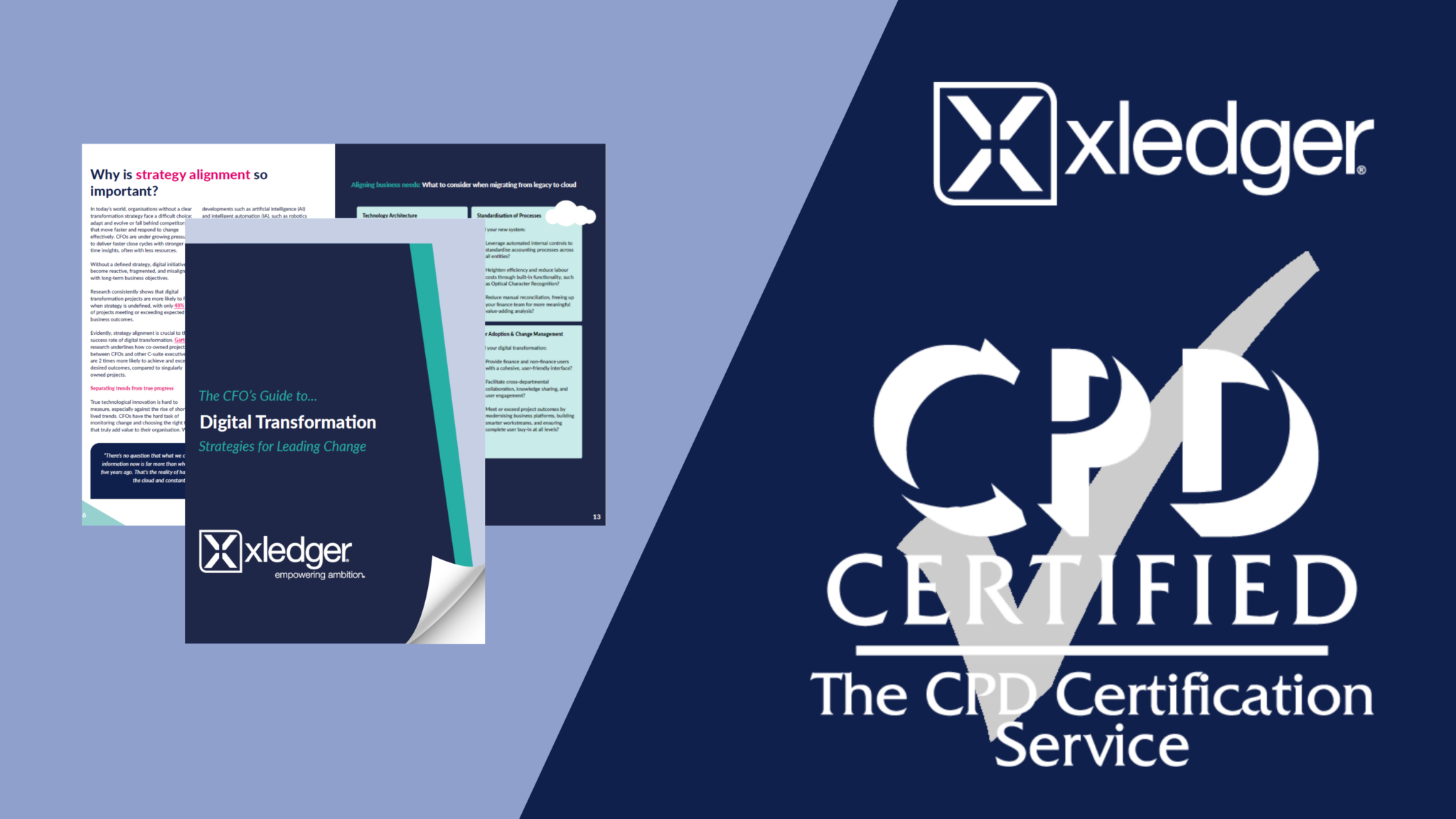
The CFO’s Guide to Digital Transformation
Welcome to Xledger’s CPD-Certified guide.
Our guide unpacks the risks of digital stagnation and offers key performance indicators (KPIs) that CFOs can use when measuring transformation success. Featuring expert insights, you’ll discover the steps to scoping a new finance system and critical questions to ask when aligning finance and wider business needs.
Complete the learning to receive:
- CPD certificate
- Accompanying learning materials
Get in touch
Have any questions on Xledger’s finance software?
Get in touch with one of our dedicated team members.
Contact person