Norway
 Sweden
 Finland
 United Kingdom
 Denmark
 United States
In our recent webinar, Unlocking In‑Depth Financial Analysis in Colleges, Xledger experts, Lucy Fenwick, Business Development Manager at Xledger, and Sam Dodge, Solutions Manager, explored why strong financial reporting structures and flexible finance systems support agile Further Education (FE) decision-making.

Further Education (FE) finance teams are under mounting pressure to deliver transparent, accurate, and fast financial reporting, and, as Xledger’s experts highlighted, the industry must navigate regulatory and operational challenges while continuing to provide high-quality education.
Are you a college finance leader struggling to gain real-time insights to support decision-making? Visit our market page or get in touch with one of our dedicated team members to discuss how Xledger’s powerful reporting and BI dashboards can strengthen compliance, agility, and financial control for your institution.

Unlocking In-Depth Financial Analysis in Colleges
Watch the full webinar to learn how colleges and educational institutions can access live consolidated data through powerful real-time reporting tools.

Why do educational institutions need robust and compliant reporting?
Lucy opened the conversation with the fundamental view that FE colleges operate in a highly scrutinised environment with many external bodies demanding complete transparency and accountability.
She noted that, “Colleges are accountable to a number of stakeholders such as the DfE and Ofsted. It’s important that they’re able to demonstrate how funds are being managed and spent, and stay compliant with very complex sector-specific regulations. Accurate reporting helps ensure that organisations are able to meet these obligations and avoid any sanctions.”
It’s clear that compliance is only one part of the bigger picture. Financial reporting is also crucial to strategic decision‑making, such as ensuring that senior leadership teams can balance long-term investments and funding allocation, both of which depend on accurate real-time insights.
Lucy continued explaining that, “robust financial data will enable leadership teams to make informed decisions on resource allocation, course viability, investment in facilities, and staffing levels.” She added, “With financial sustainability and regular financial reporting can manage budgets effectively and identify any early warning signs of financial risk.”
When data is timely and accurate, colleges can make data-driven decisions when identifying potential risk and strategy planning.
What challenges do colleges face during closing periods?
The discussion shifted towards gaining real-time financial insights for FE institutions. Sam noted that, “One of the most common challenges is the amount of time it takes to close the accounting period, get the numbers out of the finance system, and then transform them into relevant data which you can then share with stakeholders.”
Unfortunately, this delay is often caused by the continued reliance on spreadsheet reporting and manual reconciliation throughout the sector. Sam outlined that, when users need to download multiple reports from their finance system and merge them into complex workbooks, the workload multiplies quickly. “Not only does that take vast amounts of time,” he said, “but it can also increase the risk for the college.”
Spreadsheets are fragile, prone to errors or formula breakages. If a staff member with specialist spreadsheet knowledge leaves, Sam explained, the institution can lose vital financial understanding overnight.
These delays have a direct impact on decision-making. Departments may be forced to make choices with outdated information, limiting their ability to adapt at the pace required. The issue is not just inefficiency —it is the risk of operating in the dark. When colleges rely on slow, manual reporting cycles, opportunities to intervene early or course‑correct can be missed.
But, as Sam suggested, real-time reporting tools are the way to solve this problem: “By having tools such as real-time reporting, this then gives access to the college to make really good decisions at the time and eliminates the problem of waiting two or three weeks after month-end before understanding the numbers and then reporting on them.”
The importance of flexible, multi‑dimensional reporting
A core theme throughout the panel’s discussion was the need for flexible reporting structures that grow with a college. Sam emphasised that rigid systems are not built to evolve with institutions or adapt to regulatory change.
This is where flexible reporting dimensions play a crucial role. Sam described Xledger’s approach, explaining that “we ensure that our reporting structures are as flexible as possible, so it’s best practice to utilise dimensions.” These dimensions allow finance teams to track income and expenditure in a way that mirrors the real structure of the organisation.
Likewise, “flexible reporting structures mean that college finance teams can link different users to different data, so they can actually only see what they need to see for segregation of duties,” Sam added.
This level of flexibility supports financial oversight and control, while also empowering budget holders and department heads to take accountability for their spending. When combined with real‑time data, staff can self-serve the appropriate information they need to act quickly without compromising financial governance or creating information bottlenecks.
Three key outcomes of real‑time reporting
Lucy summarised the benefits colleges typically experience when moving towards automated, real-time financial reporting to wrap up the webinar. “Three key outcomes that we see from real-time reporting for colleges are automation, insight, and autonomy.”
“By automating core financial processes, data is available more quickly and easily. This reduces the administrative burden, moves away from spreadsheets, and can result in improved staff satisfaction because staff have time to work on more value-added, interesting activities.
Through report building capabilities with the granular access to cost centres, funds, etc., this provides more actionable insights at speed, enabling organisations to identify any early risks or opportunities for potential growth and expansion.
Finally, when budget holders have access to secure, self-serve, real-time financial data without any need for manual intervention, they have more autonomy, empowering them and the wider organisation to make informed business decisions quickly.”
Together, automation, insight, and autonomous data access represent a transformation from reporting to proactive, data‑driven financial control.
If your further education institution is still reliant on spreadsheet reporting or clunky manual workarounds, it may be time to upgrade your finance system. Book your free demo to discover how Xledger can streamline your reporting processes.

Article
The ROI of Cloud Accounting Software for Colleges
Many colleges rely heavily on government funding to operate, which prevents them from investing in software to support their mission of quality teaching. Discover the return on investment (ROI) of cloud accounting software for colleges and how automation and integration are vital to their survival.

Customer story
Arts University Plymouth
Arts University Plymouth is an independent, specialist art university with an outstanding reputation for innovation.
Guide
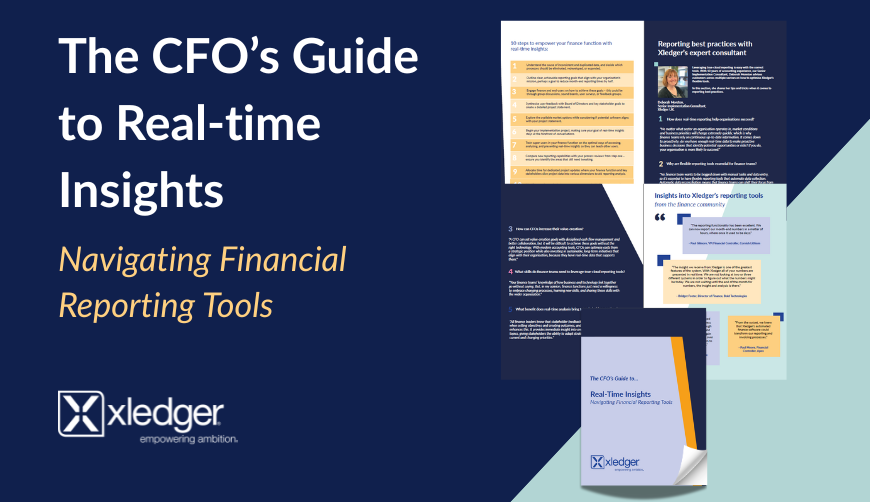
The CFO’s Guide to Real-time Insights
Download our guide to discover:
The challenges that modern CFOs may face while operating without real-time insights.
Reporting best practices with Xledger’s expert consultant.
How well you utilise your current reporting tools.
Get in touch
Have any questions on Xledger’s finance software?
Get in touch with one of our dedicated team.
Contact person