Norway
 Sweden
 Finland
 United Kingdom
 Denmark
 United States
For many growing organisations, multi‑entity structures emerge gradually when a new subsidiary is formed, the company expands across borders, or a charitable trading arm launches. However, when these structures begin to multiply, finance teams often find themselves working within outdated systems that were never designed to manage this level of complexity.

Xledger’s recent webinar, Scaling Smart: How Finance Teams can Master Multi-Entity Operations, discusses why real‑time consolidation has become a foundational capability for organisations that want accuracy, visibility, and control in their group reporting.
Hosted by Xledger UK’s Sam Dodge, Solutions Manager, and David Tillen, Senior Business Development Manager, the panel unpacks how finance teams can streamline intercompany accounts, reduce errors, and manage a master Chart of Accounts and registers. Below, we dive into the five main conversation topics from the webinar.
Are you a growing organisation looking to streamline your group financial management? Discover our features or get in touch with our dedicated team to discover how Xledger supports multi-entity organisations.
Outdated legacy systems struggle with modern group demands
Many growing organisations still rely on older, on‑premise systems built for single‑entity environments that require complex manual workarounds to perform daily accounting tasks. These systems make it difficult to maintain controlled finance structures consistently across a group, leaving finance teams to navigate separate ledgers, maintain duplicate records, and rely heavily on spreadsheets to compensate for gaps in functionality.
When systems operate in silos, finance teams cannot access a unified picture of group performance. Real‑time consolidation addresses this by ensuring that every transaction is reflected across the group as soon as it is posted. It removes the delays associated with batch updates and the risk of basing decisions on outdated, duplicated, or inaccurate information.
Modern consolidation is faster and more reliable
Traditional consolidation processes often require extensive reconciliation work, especially when intercompany activities are handled manually. Here are a few processes that create unnecessary pressures for finance teams:
- Adjustments
- Eliminations
- Late corrections
- BAU
Real‑time consolidation significantly reduces that burden by providing immediate visibility over group‑level balances and ensuring that intercompany postings remain aligned. This reduces the volume of manual checks required at period close because finance teams can trust that data is consistent throughout the month. As a result, the month‑end cycle becomes more controlled, reliable, and less resource‑intensive.

Scaling Smart: How Finance Teams Can Master Multi-Entity Operations
Watch the full webinar to learn how group organisations can access live consolidated data through multi-entity accounting software.

Intercompany processes shouldn’t dominate the working week
Intercompany accounting is one of the biggest sources of duplicated work in multi‑entity finance. Staff who use outdated systems typically switch between systems, repeat entries, and reconcile numbers manually. This is not only time-consuming but also increases the risk of manual input errors that are difficult to trace later.
Real‑time consolidation changes the nature of this work. A transaction posted in one entity can automatically generate the corresponding entry in its counterpart. Approvals can be applied consistently, and month‑end reconciliation becomes a simple confirmation rather than an investigative exercise. As a result, teams spend more time on value‑adding tasks and far less on correcting administrative issues.
Reporting should be transparent and useful to stakeholders
Boards and senior leaders increasingly expect group‑wide financial insights on demand. However, when reports depend on manually consolidated spreadsheets, they inevitably lag behind business activity, leaving decision-makers operating without real-time insights. Ultimately, this limits the organisation’s ability to respond to emerging trends, risks, or opportunities in a timely and informed manner.
Modern finance software with real-time consolidation creates a consistent reporting foundation. Group profit and loss, balance sheets, cash flow information, and spend analyses can be refreshed instantly through live dashboards that are tailored to specific users. Finance teams can drill down from group results to individual transactions without exporting data or building temporary workbooks, marking a clear shift where reporting aids decision-making rather than simply documenting it after the fact.
Modern finance systems support growth
Introducing a new entity should not mean repeating an entire implementation process. Yet many organisations face exactly that when their finance technology lacks a unified structure. The result is additional cost, duplicated configuration work, and delays that make it difficult to respond quickly to organisational change.
A finance system that supports real‑time consolidation typically operates from a single, consistent architecture. This means a shared Chart of Accounts, uniform supplier and customer records, and a controlled framework for adding new entities. When new companies can inherit existing configurations, scalability becomes much more manageable, and finance teams avoid the operational disruption often associated with structural change.
Why real‑time consolidation is becoming essential for the mid‑market
Mid‑market finance teams are expected to deliver the same standards of accuracy and insight as large enterprises, but with fewer resources. Real‑time consolidation helps bridge that gap. It strengthens data governance, reduces reliance on spreadsheets, and increases the reliability of month‑end reporting. It also improves team morale by removing repetitive tasks that often lead to errors and frustration.
Real‑time consolidation does more than speed up processes. It supports better decision‑making, enables finance teams to operate more confidently, and ensures the organisation has the clarity it needs to grow without compromising consistency or control.
If you’re struggling to control your multi-entity finances, book your free demo with our expert consultants and discover how Xledger builds efficient, effective financial processes for complex group structures.
Guide
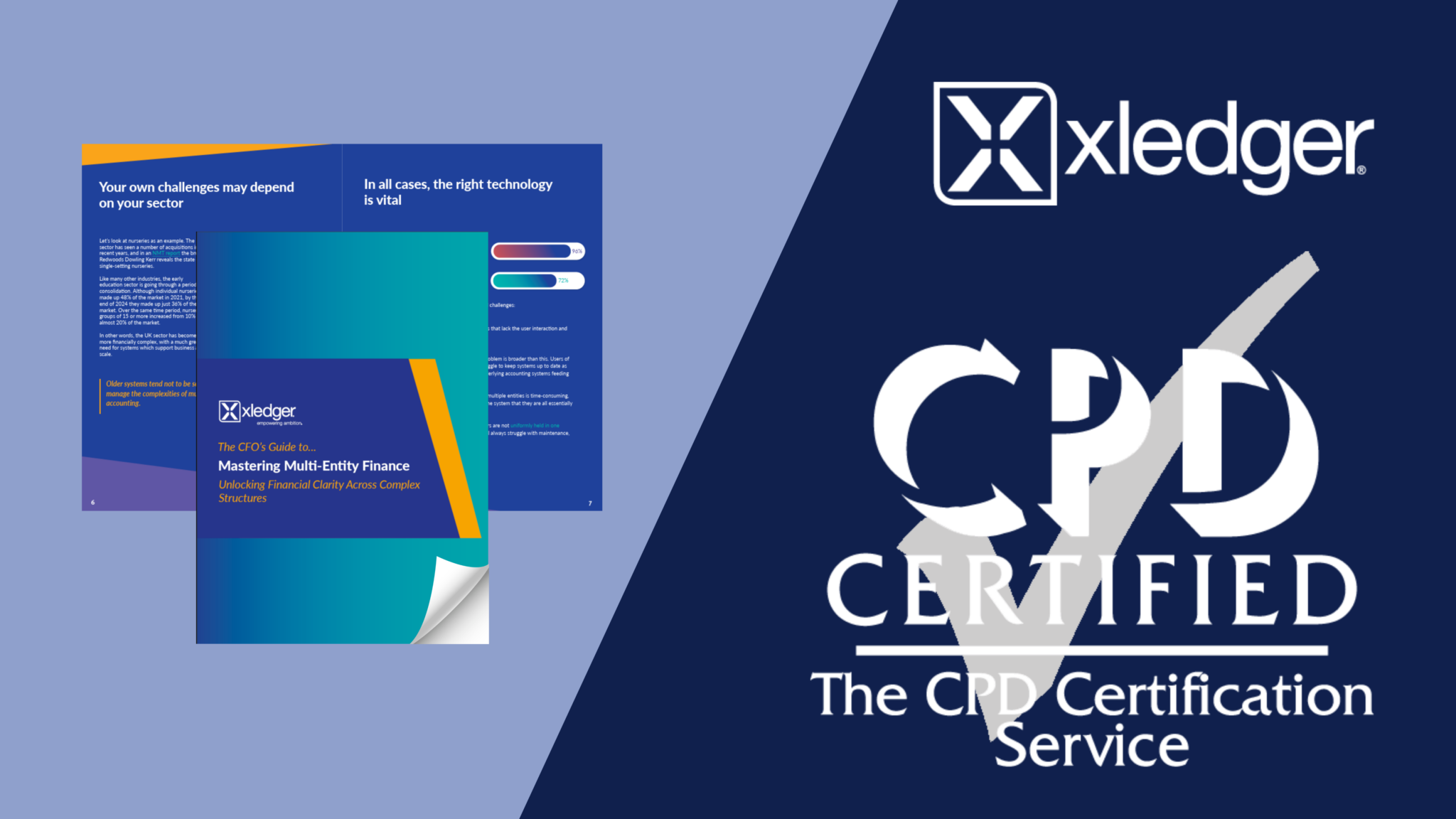
Mastering Multi-Entity Finance
Welcome to Xledger’s CPD-Certified guide.
Are you a finance leader of an expanding business with multiple entities?
Our guide to Mastering Multi-Entity Finance explores the challenges faced when working with a multi-stranded business, the pitfalls of using legacy systems, and how a centralised hub can improve your insight into group financial health.
Complete the learning to receive:
- CPD certificate
- Accompanying learning materials

Customer story
Cornish Lithium
Founded in 2016, Cornish Lithium is an innovative mineral explorations and development company committed to securing a sustainable, ethical and environmentally responsible lithium supply for the UK.

Article
Multi-Entity Accounting Software Explained
Financial management can be intimidating for organisations looking to expand beyond a single entity. Fortunately, multi-entity accounting can serve as an integrated solution for parent businesses that oversee multiple companies and diverse entities.
Get in touch
Have any questions on Xledger’s finance software?
Get in touch with one of our dedicated team.
Contact person