 Norway
 Sweden
 Finland
 United Kingdom
 Denmark
 United States
Carbon accounting underpins one of the most significant topics of this decade: environmental, social, and governance reporting (ESG). Pip Ross, Director of Finance & IT at We The Curious, and Xledger’s Deborah Moreton discuss how the charity venue has navigated the pressures of ESG regulations.
“A lot of the time, charities I speak to want to dive straight into ESG and carbon accounting. However, when I ask further questions, the consensus is clear: charities want to report on ESG but don’t know where to start.”
Deborah Moreton, Senior Implementation Consultant
Xledger UK
Deborah Moreton, Senior Implementation Consultant at Xledger UK, joined forces with Pip Ross, Director of Finance & IT at We The Curious, to deliver their expert insight on ESG and Carbon Accounting at the 2025 Charity Finance Summit.
The key message the speakers were keen to convey is that ESG reporting, no matter the size of the charity, must not be treated as a tick-box exercise.
Continue reading to learn:
- How and why ESG regulations affect charities.
- Real-world examples of how We The Curious navigated the tensions that emissions tracking created between ESG strategy and finance.
- The difference between activity-based and cost-based carbon accounting, and how a hybrid model may work best for your organisation.
Are you a tier 3 charity looking to align your sustainability reporting with your organisation’s objectives, or a smaller charity hoping to grow into the next tier? Visit our market page or get in touch with us to discuss how our expert consultants can advise you on the best way to navigate the additional reporting burden.
What is ESG, and how does it affect charities?
ESG is a method of reporting that displays an organisation’s impact on environmental, social, and governance factors. For charities, the effect manifests as additional reporting and compliance burdens in an already regulatory-complex sector.
The various tiers and scopes will affect charities in different ways.
Tier 1: Charities with a gross income of up to £500,000
Tier 2: Charities with a gross income between £500,00 and £15,000,000
Tier 3: Charities with a gross income of above £15,000,000
The new Charities Statements of Recommended Practice (SORP) regulations mandate that, from 1st January 2026, tier 3 charities must report on their ESG. Tier 1 and 2 charities should report on them (essentially, it is encouraged, but not mandated).
Scope 1: Emissions that an organisation generates directly, such as travel or delivery emissions, heating, and air conditioning units.
Scope 2: Emissions that an organisation emits directly, such as electricity used to run an office, factory, or community centre.
Scope 3: Emissions that are generated across an organisation’s supply chain. These can be indirect, upstream, or generated by employees for business travel, as well as financial choices, such as selected investments and banks.
Scope 1 and 2 emissions can be controlled relatively easily by an organisation, although this ease doesn’t take costs into account. Conversely, because emissions are within a supply chain and not directly emitted by an organisation, scope 3 emissions are far more difficult to control, track, and report on.
If you want to understand the breakdown of tiers and scopes, read our full breakdown of the tier structure, or our in-depth dive into government-mandated ESG reporting.

Article
Staying Compliant: What is ESG and Why Do We Need It?
ESG is a corporate sustainability concept that identifies a company’s impact on the environment and society. It’s fast becoming a major buzzword in accounting and finance circles as it aims to capture a business’s measures on climate, diversity, equality, and inclusion.

Article
Breaking Down the Changes in the New Charities SORP
We break down the benefits and drawbacks of three major changes within the new SORP for charities, with insight from industry experts on how the changes may affect organisations in Scotland, the Republic of Ireland, England, and Wales.
A real-world example: We The Curious’s emissions tracking
Pip recognised that scope 3 emissions are the most slippery ones to monitor. She notes, “One of the biggest scope 3 emissions is travel. As a science venue, we had to think of ways to make our car park, a key source of income, as sustainable as possible. We have school trips that arrive on diesel coaches; Scope 3 emissions are challenging to control, so problem-solving these emissions is essential to ESG strategy.
Similarly, refreshing exhibitions can be very intensive from a capital perspective. It’s up to finance to work with a multitude of stakeholders and find the most sustainable way of finding resourcing.”
“I totally agree,” added Deborah. “Location-based charities, like wildlife parks or conservation areas, encourage tourists to witness nature, but to witness it, tourists must travel. It’s a real balancing act.”
Another example, and a hot topic, is the impact of artificial intelligence (AI) on the Earth. Pip explained, “We’re exploring if it’s possible to implement AI sustainably. ESG threads through everything we do. It’s not just for our sustainability team, in the same way carbon accounting isn’t just for finance.”
We The Curious’s key learnings
After discussing We The Curious’s approach to defining the challenges of tracking their emissions, Pip outlined her organisation’s key learnings, including examples from stakeholder relations to accounting best practices.
We The Curious’s key learnings unpack:
- How to manage the tension between financial management and ESG strategy.
- The best ways to focus financial efforts and support ESG measures.
- Tips on embedding ESG into day-to-day finance.
- The significance of setting realistic and achievable net-zero targets.
Key learning: Managing the tension between finance and ESG
Pip emphasised that, as a finance leader, it’s her and her team’s priority to find the most cost-effective ways of achieving We The Curious’ community objectives. However, ESG can sometimes strain this mission.
“There are inherent tensions between finance and sustainability teams because, more sustainable options are often more expensive, and, as finance, we’re looking for the most cost-effective, efficient, and proper ways of doing things.”
To combat these tensions, Pip suggested keeping the following three aspects in mind:
- Finance doesn’t always trump sustainability.
- Delivering decarbonisation is a business-wide goal; therefore, it is a finance goal.
- And, the argument that there’s a better value for money doesn’t always align with ESG strategy.
“In other words,” Pip reiterated, “Finance needs a strategic option behind it to keep it aligned with organisational values.”
Key learning: How to focus finance’s efforts
Pip offered a working example of how We The Curious was able to focus its financial efforts on achieving the organisational sustainability target.
“We looked at our highest costs, and cleaning and catering were first and second, respectively. If we’d have looked at spend alone, we’d have been cornered into looking at sustainable cleaning products. But, by overlaying the emissions factor behind the highest spends, it became clear that catering has a greater impact in terms of tonnes of carbon emissions.
It meant that, although we spent more on cleaning, we identified that catering emissions were higher. By marrying spend and emissions together in carbon accounting, it allows you to determine which suppliers or projects you need to assess and scope for movement.”
Pip continues by reassuring the audience that carbon accounting is not an exact science. Instead, it’s a process with lots of nuance, but one that helps organisations channel their limited resources into a focus to have the biggest impact.
“It’s important not to see carbon accounting as an end to itself,” Pip rounds up. “As an accountant, it can seem like another thing at the end of a very long list of reports you need to create. But marrying up spending with emissions factors has enabled us to focus our sustainability efforts better.”
Key learning: Embedding ESG into everyday objectives
Carbon accounting underpins ESG, but it’s not the full story. Because of this accounting process, it’s easy for organisations to push the burden of ESG onto finance, but for ESG strategy to be successful, it’s crucial that C-Suite executives lead from the top.
Deborah affirmed this: “ESG must come from strategy and stakeholders. This isn’t limited to good buy-in from the top — it involves end users, senior leadership, trustees, and all other stakeholders.”
Continuing this conversation, Pip recognised that ESG strategy should inform organisational objectives. “In 2019, we declared a climate emergency. As a science centre, we did this because we understood the importance of educating our local community. However, without a robust ESG strategy, we wouldn’t have been able to lead that discussion.”
“We created our sustainability team and, although they are one of our newest departments, it shows how easily you can embed ESG strategies within an organisation.”
Key learning: Set realistic decarbonisation targets
Another key learning for We The Curious was setting achievable targets. Pip emphasised the importance of setting a baseline target to ensure all other targets are realistic.
She continued, “Originally, we set ourselves the target of being net zero in scope 1, 2, and 3 by 2030. But, after reevaluating the complexities of controlling our scope 3 supply chain, we re-grouped, re-targeted, and made sure our new goal was achievable.”
“Although we’re already net zero in scopes 1 and 2, there’s little chance we can achieve scope 3 net zero in the next few years, purely because of the volatile and uncontrollable nature of scope 3 supply chains.”
As a result, We The Curious set itself a new sustainability target:
A site powered without fossil fuels, using fully renewable electricity, and a 30% reduction in offsite carbon emissions by 2030 (against 2019 baseline).
It’s important for charity finance leaders to realise this is not an isolated issue; many charities will be feeling this pressure, and finance leaders don’t have to navigate pressures alone. There are ESG focus groups, events, and consultants that can advise organisations on the best ways to tackle ESG reporting. Equally, software providers can consult on how to optimise solutions to support real-time emissions tracking and compliant reporting.
Activity-based vs. Cost-based: What’s the difference?
As the discussion progressed, Deborah and Pip outlined the differences between activity-based and cost-based carbon accounting, highlighting that cost-based accounting offers a broader application, while activity-based accounting is more focused. Ultimately, the two methods complement each other.
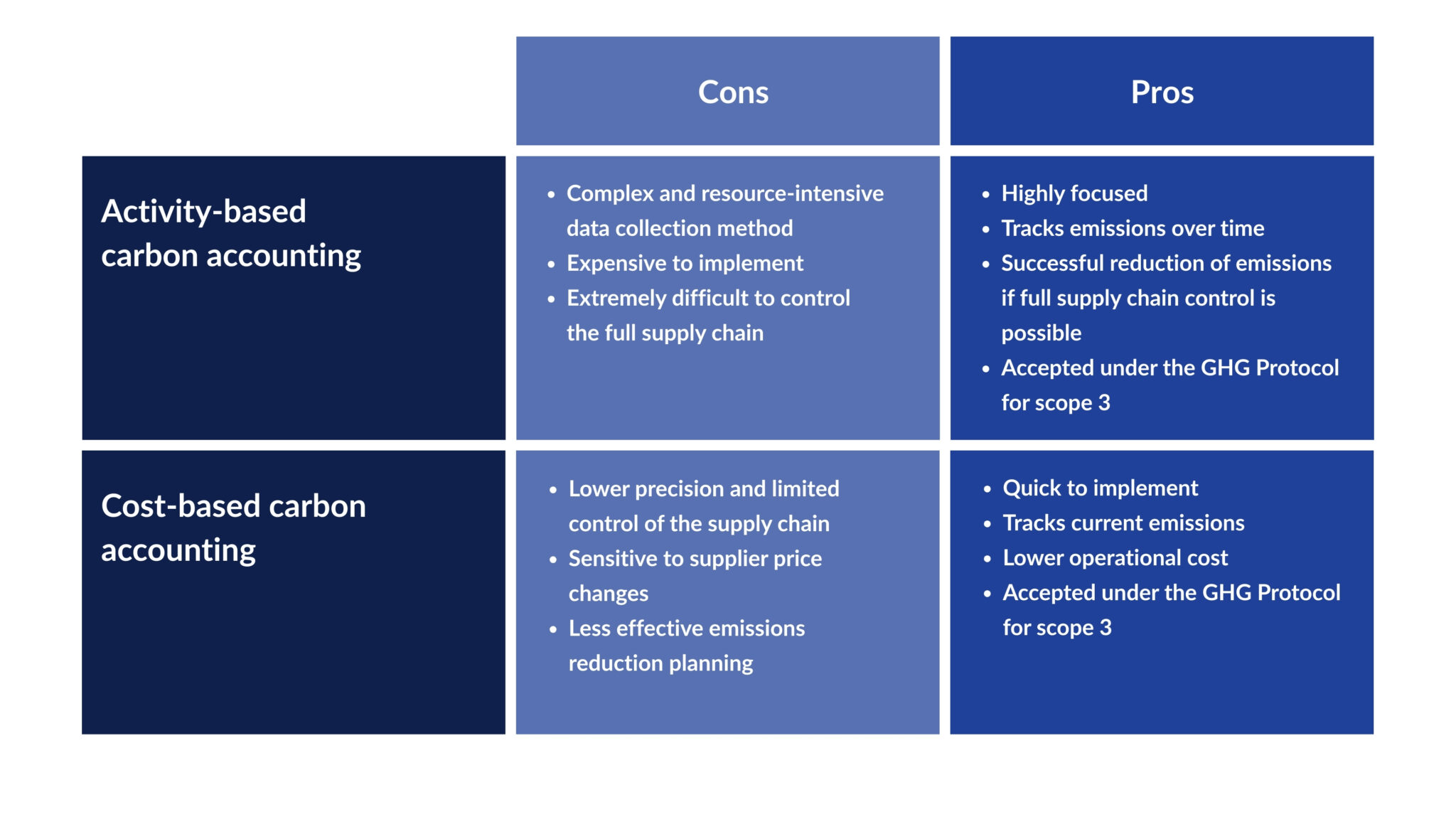
“Activity-based carbon accounting uses real-world operational data, like kWh of electricity,” Deborah explained, “allowing you to take the accurate and granular information from electricity invoices to aid scope 2 emissions tracking. However, this type of detail is hardly ever available for scope 3 suppliers. Unfortunately, it would take masses of time and resources to find out this information.”
Deborah went on to explain cost-based carbon accounting: “In this method, I have supplier invoices, costs, and emissions factors. I multiply the costs by the emissions factors and convert them into the CO2 equivalent.
This is less resource-intensive, easier to identify key focus areas, and avoids investing in additional monitoring equipment. The downside is that it relies on averages.” Deborah admitted. “Unless you have a specific emissions factor per your individual suppliers, how do you know which emissions factor applies to that particular supplier?”
A real-world example: We The Curious’s hybrid carbon accounting
For organisations with a significant number of suppliers, getting activity-based data from them all can be a big Challenge. Instead, organisations can take a strategic approach to choosing a small number to start with. Pip recognised that We The Curious has already taken this hybrid approach to carbon accounting, and is now working on how to engage its suppliers for more activity-based data.
The speakers agreed that a hybrid approach would be the best way forward for many organisations. “Cost-based accounting highlights the areas to focus on. With activity-based, you can hone in on those areas,” Pip observed.
She continued, “We take our chart of accounts, our general ledger codes, and in the background, we map each of those codes against Standard Industrial Classification codes, as these have associated emissions factors. Here we can look at spending on a chart of accounts code and automatically apply an emissions factor to it.”
“There are limitations, of course. Our COA was set up to deliver our finance function primarily,” says Pip. “Some information is on the broader side of what our sustainability team would like. Despite this, the hybrid method gives finance leaders enough information to help them achieve both financial and ESG goals.”
Next steps for charity finance leaders
The speakers reiterated the sentiment that finance leaders are not alone. Leading from the top, attending focus groups and ESG networking events, ensures finance leaders can drive engagement within their organisation and encourage complete staff buy-in.
“This applies to trustee boards, too,” Pip stressed, highlighting the importance of aligning strategically across the whole organisation.
“Gathering representatives from each area of your organisation is a good place to begin.” Deborah offered. “And don’t be afraid to reach out to local corporate businesses for their input; sustainability benefits everyone, particularly your local community. You may find they offer donations or support to help you achieve your ESG strategy.”
The speakers concluded on a resounding note: Everyone needs to be involved for an ESG strategy to be embedded, so the earlier you face carbon accounting, the easier it will be to achieve your sustainability and financial goals.
Are you a charity or not-for-profit finance leader who wants to align ESG and finance strategy? Get in touch to discuss how Xledger can support your organisational objectives.
FAQs
Yes, Xledger’s carbon accounting module helps organisations adhere to ESG regulations. Because Xledger is constantly being developed, our customers can rest assured that our software supports the latest reporting regulations and compliance standards. Discover more about our carbon accounting module here.
Our customers can add modules to their existing Xledger software by requesting a discovery call via their customer success executive to scope the work. For example, our implementation consultants can add the carbon accounting module to your configuration to help streamline your ESG reporting.
Charities can begin by calculating cost-based carbon units with readily available data, such as bills, fuel, spend, and procurement, then layer activity-based calculations to create more impactful insights into carbon output.
Get in touch
Have any questions on Xledger’s finance software?
Get in touch with one of our dedicated team.
Contact person


ESG Reporting and Carbon Accounting – Built Into Xledger
Discover how Xledger is helping organisations and their partners stay ahead of ESG expectations — without adding hours of manual work.
Webinar
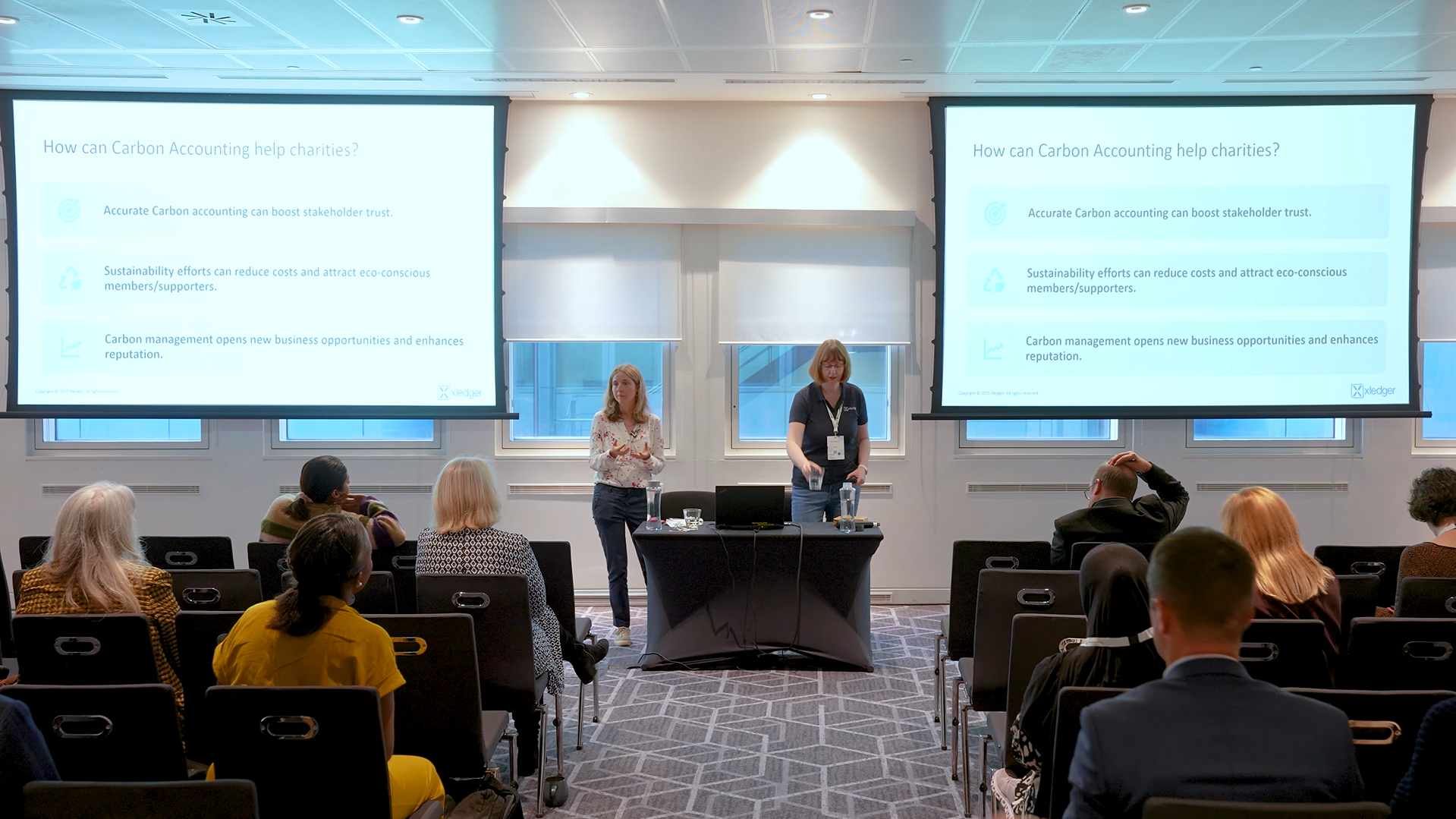
ESG and Carbon Accounting: What Charities Need to Know – Charity Finance Summit 2025
This speaking session covers:
- How charities can automate ESG reporting while ensuring they comply with SORP regulations
- The valuable insights that ESG and carbon accounting can uncover across not-for-profit organisations
- A real-world case study from We The Curious, exploring how the science centre simplified carbon accounting

Market
Not-for-Profits and Charities
Control, insight, and compliant SORP reporting for organisations.