Norway
 Sweden
 Finland
 United Kingdom
 Denmark
 United States
In summer 2025, Xledger experts Samuel Dodge & Robb Webb, unpacked the reasons why the Charity and Not-for-Profit sector often struggles to access real-time financial insights. During the Xledger webinar, Unlocking In-Depth Financial Analysis in Charities, the experts shared practical tips on how to empower staff, both finance and end-users, by utilising powerful reporting tools.

What obstacles do charities face when accessing real-time data?
To open the webinar, Sam highlighted the reasons why charities and not-for-profit organisations face risks when reporting, indicating that an over-reliance on spreadsheet reporting is a major risk for complex charities. He noted that, “for multi-entity charities, you’ll be downloading multiple pieces of data, putting that into an Excel spreadsheet, then having to manipulate that data to hit those reporting requirements.”
Not only is this inherently risky, as Excel spreadsheets are highly editable files that do not contain source data, but formulas can also break, lengthening the time it takes to deliver information that supports business decisions. Samuel continued, “Without real-time insights, a charity’s growth is stunted, and its finance team can end up reporting reactively rather than proactively.”
Other hurdles that charities and not-for-profits face when reporting include:
- A lack of regular data reviews: Poor internal controls can lead to excessive coding errors that must be fixed in bulk before financial reporting can commence.
- Legacy system reporting: Older, on-premise systems cannot cater to the level of real-time insight that the charity sector needs for accurate fund reporting.
- Regulation changes: Some systems cannot adapt quickly enough to new regulations, for example, amendments to SORP and ESG. This can cause delays or misunderstandings and affect the quality of financial reports.
Ever-evolving reporting demands
Charities and not-for-profits have always faced stringent reporting requirements, and these are ever-evolving as technology and the environment change. With the introduction of Environmental, Social, Governance (ESG) reporting for charities with a turnover of over £500,000, stringent parameters are only set to increase.
By relying on spreadsheets or legacy systems, charities may struggle to meet complex reporting requirements, like those set out in SORP. [1] As a result, the charity’s finance functions may develop an over-reliance on spreadsheets, with more and more data becoming siloed behind complex formulas.
Substantial organisation growth
The recent growth in the charity sector, particularly food bank not-for-profits, has led to organisations needing to adapt quickly to evolving styles of reporting. These styles encompass various audit thresholds, including different financial statements or altered accounts, as well as innovative ways of presenting donor and funding reports to new donors.
New ideas and experiences
Fresh ideas are an essential cog in a charity’s mechanism, but they are not without risk. Often, when new financial directors (FDs) or chief financial officers (CFOs) join a business, they bring new ideas about how to re-style management accounts, which places pressure on manual reporting.
Sam stated, “New individuals will bring new ideas, through KPIs, statistics, or templates inspired by previous experiences. However, this then requires new reporting styles to help bring these numbers to life.”
It’s completely understandable that those accountable for compliant reports — FDs and CFOs — have strict internal guidelines on how things should be done. However, when a manual system cannot support these guidelines, finance staff are left feeling overworked, spending more time on manual workarounds than producing valuable accounting insights.
High turnover due to a lack of software
Sam highlighted how finance teams can become demotivated when tied to excessive manual reporting in Excel spreadsheets, a root cause of high staff turnover. Demotivation then turns to frustration when budget holders struggle to access real-time information, as finance becomes inundated with basic requests.
Without modern technology, budget holders are left asking basic questions:
- What does this invoice mean?
- How much budget is left?
- Have I paid these suppliers?
Unfortunately, this prevents stakeholders from reaching self-sufficient data access and increases bottlenecks throughout the whole business. Sam pointed out the importance of technology and how the right tools can remove overload and empower staff:
“If budget holders are waiting for finance teams to understand how much budget they have, they may not be able to make the correct decisions to help impact the charity’s goals. We really want to encourage non-finance users to access their data, and to interrogate that data, to help influence decisions within their organisations.”

Unlocking In-Depth Financial Analysis in Charities
Watch the full webinar to learn how charities and not-for-profits can gain deeper financial insights through real-time reporting tools.

So, what is best practice? And how can you set up your team for success?
Real-time fund tracking
Tracking restricted, unrestricted, and designated funds in real-time is vital information that supports a charity’s community mission. Armed with this data, the organisation can decipher where to allocate funds for research, marketing, fundraising, and other internal resources.
As this style of reporting is all automated, the panel emphasised that budget holders gain a clear understanding of what they’ve spent, and what remains. Not only does this help support the charity’s goal, but it also presents the unrestricted funds that are available to aid charitable offerings.
Simple, intuitive coding
The panel discussed how simple, intuitive coding ensures that everyone’s chart of accounts and reporting dimensions are easy to use. By leveraging one-to-one or one-to-many relationships between project codes and account data, finance teams can improve their data accuracy.
Not only does this save time, but it also automatically links the correct project or fund to the appropriate transaction, improving confidence in numbers and creating more meaningful data insights.
Flexible reporting dimensions
As charities evolve, so must their reporting capabilities, and flexible, multi-dimensional reporting is a must-have for any charity looking to analyse its numbers and drill down into the transaction level. Sam demonstrated that, within a configurable system, not-for-profits and charities benefit from a “completely user-defined chart of accounts that is built up by account groups in a hierarchical structure”.
These different dimensions include:
- Cost centre or departments
- Project register
- Specific fund accounting dimensions
- Three additional dimensions
Multiple dimensions increase insights for charity and not-for-profit organisations through slice and dice reporting. Sam emphasised that the fund register provides incredible intel to finance teams during projects: “We typically see the fund register utilised for fundraising campaigns and being able to slice and dice data in real-time.”
Automated reporting
Automation is foundational to ensuring that charities and not-for-profits maintain financial insight. Without it, reporting dimensions, intuitive coding, and real-time fund tracking fail to provide live information to charity finance teams.
Charities that leverage automated reporting processes increase control, ultimately ensuring that data accuracy and accessibility are heightened.
Sam underlined the benefits of automated live reporting for non-finance users. He suggested, “It’s important to empower users to get an understanding of budgets and numbers”. Easy-to-use dashboards and reports support real-time decision-making because budget holders can use charts and graphs to help visualise their spending.
Key takeaways
Unlocking in-depth financial analysis is no small feat. Although it requires strategic planning from C-suite executives and a culture of communication and collaboration, ultimately, delivering real-time insights comes directly from robust reporting tools.
By recognising a need for change and acting strategically, charities and not-for-profits can gain meaningful insights into real-time fund tracking and community objectives. Contact a member of our dedicated team to book your free demo, and learn more about Xledger’s real-time reporting functionality.
Webinar hosts:
- Samuel Dodge, Solutions Managerat Xledger UK.
- Robert Webb, Senior Business Development Manager at Xledger UK.

Webinar
The Xledger Podcast: How Charities and Not-for-Profits can Avoid the Pitfalls of Implementation Part 1
Listen to learn:
- How charities and not-for-profits can benefit from digital transformation
- How to build a business case to get buy-in from all teams
- When to compromise on software implementation, and when not to
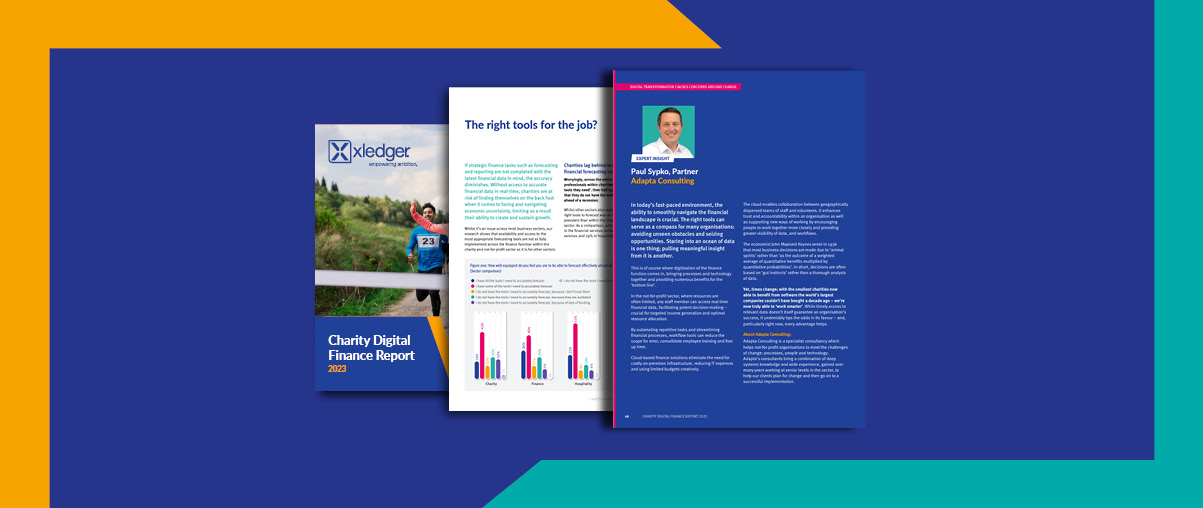
Guide
Charity Digital Finance Report
Key points:
- What is preventing charities from unlocking their needs for better financial reporting?
- What benefits do charities who have digitally transformed see?
- What support do finance teams need in their journey?

Customer story
Comic Relief
Comic Relief started their Journey with Xledger in 2023, moving from a system that was 20 years old to a modern system that could meet their needs.
Get in touch
Speak to one of our dedicated team members for more information on how Xledger can support your business.
Contact person