Norway
 Sweden
 Finland
 United Kingdom
 Denmark
 United States
The Fintech Benchmark report revealed that 71% of UK financial services firms believe migrating from legacy technology is a major problem confronting their operations. [1] In this article, we shortlist 5 risks that banks and wealth management firms face when using legacy finance software.

5 risk areas of legacy finance systems
Legacy on-premises finance systems are not built to support banks and wealth management firms with the flexible financial management needed in today’s world. This presents a growing concern among the industry: how do we migrate from technology that is heavily embedded in day-to-day processes?
With these risks in mind, if your financial services business is looking to move from legacy technology and modernise its finance system, get in touch or discover how we support companies like yours in their cloud migration.
Risk 1: Increased vulnerability to cyber and data breaches
Cybersecurity is a large stressor for banks and wealth management firms, and rightly so. Accenture and Ponemon Institute found that the cost of cybercrime in the financial services industry is 40% higher than the average across other sectors. [3]
If, according to Central Banking, 71% of surveyed banks are struggling to adapt their legacy systems [1], then the same percentage are still reliant on legacy software to support their businesses, meaning they have limited software that adheres to current encryption standards, such as Multi-Factor Authentication (MFA) and Single-Sign On (SSO). By continuing to use legacy finance software, these firms will continue to face cybersecurity obstacles as their version of software reaches the end-of-support or end-of-life.
As cybercriminals are more likely to target the financial services industry, banks and wealth management firms should take measures to adopt modern, cloud-based finance software that adheres to regulations, such as those in the FCA’s Rules & Operational Resilience and the Payment Card Industry Data Security Standard (PCI DSS).
Solution:
- Perform regular system reviews to ensure business systems are working hard for your organisation.
- Note down inefficiencies to support your business case of migrating from legacy finance software to a cloud-based finance solution.
- Ensure your legacy migration strategy includes a robust project scope that supports cybersecurity, now and in the future.
Risk 2: Regulatory non-compliant and inconsistent reporting
Another significant risk to Finserv companies is the inability to produce compliant month- and year-end reports. Access to flexible real-time reporting is vital for any financial services business, as it ensures money and information handling are transparent, legal, and compliant with industry regulations.
Without compliant reporting, Finserv firms can face vast legal fines, as well as a reputation setback. 70% of UK and US banks admitted to feeling inadequately equipped to face regulatory change due to inefficient legacy technology. [4]
Legacy or on-premises finance systems often demand considerable workarounds, updates, or re-installs to ensure that the organisation is compliant. However, with dozens of contracts, from maintenance and labour to upgrades and bug fixes, keeping the risk of non-compliant reporting at bay is extremely time-consuming and open to error.
Solution:
- Create a process inefficiencies review document and share it with your finance team.
- Ensure each process is documented. This may be difficult during busy month-end, but taking time to complete it will benefit your understanding of which processes are causing your reporting to become non-compliant.
Risk 3: Fragmented systems and inaccurate data
Following the previous risk, a catalyst for regulatory non-compliant reporting is the use of disconnected or poorly integrated systems, resulting in inaccurate or duplicated data. And, data that is littered with inconsistencies will fail to help finance functions identify risk exposure against tolerance levels.
The Prudential Regulation Authority’s (PRA) “Dear CEO” letter outlines that the regulatory body views legacy technology vulnerabilities as a top threat to the data security and quality of UK financial services firms, alongside third-party disruptions and cybersecurity. [5]
Managing the risks that disconnected or bolted-on finance technology can bring is becoming increasingly difficult as legacy software providers switch off support for on-premises versions.
While the “aggregation of data” often creates fear, Finserv finance leaders can mitigate these risks with confidence by partnering with a cloud finance software provider that integrates with risk management software and other financial management business platforms. With a single source of truth and a best-in-class finance solution, banks and wealth management firms can confidently identify and manage risk in real-time.
Solution:
- Investigate the manual workarounds that your current connected business platforms create.
- Revisit the old integration scope to check if the current integration matches your original project objectives.
- If it fails to meet initial targets, you can add these obstacles to your business case of why migrating from legacy finance software is the best way to manage risk.
Risk 4: Lack of audit trails and excessive manual workarounds
Legacy systems often drive an over-reliance on Excel spreadsheet reporting, which creates risk for financial services in two key ways: formulas can break, losing evidence, and spreadsheet reporting lacks robust version control.
If formulas break and evidence is lost, then Finserv finance functions increase risk because they cannot attach the appropriate supporting documentation directly to each posting. This is increasingly damaging for banks, in particular, as investing customer money is integral to their growth. And, without transactional evidence, banks and wealth management firms are non-compliant.
Similarly, a lack of version control that ensures transactional history is logged and audit trails are automatically created means that all supporting evidence is insufficient. Too often, spreadsheets are viewed as controlled environments that support financial management; in reality, they are highly editable, unstable files.
Solution:
- Introduce internal controls that follow accounting best practices and a segregation of duties.
- Ensure your finance function and the wider business understand the reasons why robust and straightforward controls are necessary to gain user buy-in.
Risk 5: Limited and delayed access to financial information
Finally, the financial service industry is inherently competitive, and delayed access to accurate financial data can stunt an organisation’s growth. Legacy technology, particularly versions that are unsupported or end-of-life, cannot provide the robust financial management tools needed to remain competitive in commercial markets.
Even if a bank’s legacy finance system is still supported, the inherent nature of legacy technology means that it will soon become unsupported as providers move customers to similar systems retrofitted for the cloud. As such, at any stage in its life, legacy technology will always create risk.
This risk becomes even more potent when the technology limits or delays access to financial data that could identify risk early. Reporting is slower, inaccurate, and as soon as reports are created, they become obsolete, failing to support decision-makers with real-time, flexible, visual data.
Solution:
- Consider how moving to the cloud will benefit your organisation’s ability to make agile decisions and mitigate risk.
- Brainstorm the vulnerabilities your organisation faces without access to powerful real-time reporting tools.
- Discuss the implications of delayed access to financial information with C-Suite stakeholders to ensure complete legacy migration project buy-in.
Key takeaways
Financial services need financial oversight to sustain growth. Without it, an organisation can fall behind competitors. Unfortunately, legacy technology cannot support long-term success, leading to poor decision-making and misidentification of risk.
To combat this, Finserv finance leaders can create a robust business case for migrating from legacy finance software to a modern cloud accounting solution. Book your free demo with our in-house accountancy-trained solution consultants to discover how Xledger’s future-ready finance software can help your business succeed.
FAQs
Legacy finance systems increase Finserv risk as they are reliant on manual processes, making it harder to maintain accurate records, audit trails, and regulatory compliance.
Modern finance systems, like Xledger, are built on rule-based controls that automate core and complex accounting processes. Also, modern systems provide automatic audit trails that help Finserv companies meet regulatory requirements.
Yes, outdated finance software increases the risk of reporting errors, such as inaccurate, duplicated data and missed deadlines.

Customer story
Lothian Pension Fund
Lothian Pension Fund (LPF) is one of Scotland’s largest local government pension funds and has supported more than 75,000 local government workers and their families in achieving a financially secure retirement.
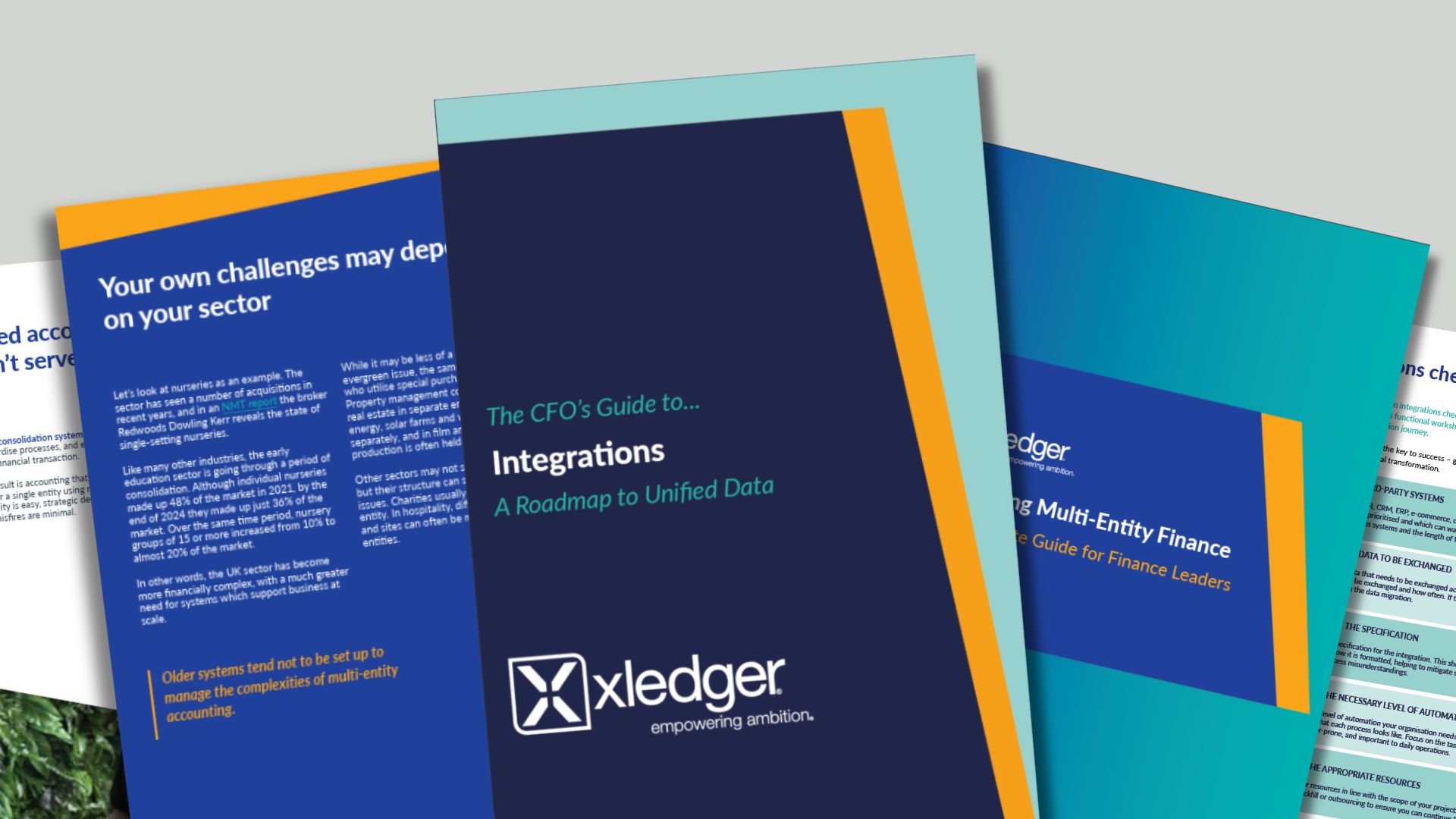
Guide
Series: The CFO’s Guide to…
On average businesses stay with the same finance software for 5-7 years, so the pressure is on to get it right when looking to change or invest in new finance software. In this series of guides, we dive into 5 key areas CFOs and finance teams should be clued up on when looking to change accounting systems. We hope you enjoy.

Webinar
The Xledger Podcast: Scoping and Implementing a Finance System Part 1
Welcome to the Xledger Podcast, a CPD-Certified series focusing on all sectors.
In part one of this two-part series, our team of experts from Xledger explore the scoping and implementation of a new finance system featuring Tim Wright (Operations Director), Zheng Zeng (Consulting & Support Manager), Ana Rodrigues (Project Manager), and Robb Webb (Senior Business Development Manager). Learn about their insights and experiences from working on finance transformation projects.
Complete the learning to receive:
- CPD certificate
- Transcript
- Accompanying learning materials
Get in touch
Have any questions on Xledger’s finance software?
Get in touch with one of our dedicated team.
Contact person